

Plants and Animals
Packera insulae-regalis Isle Royale ragwort
Key Characteristics
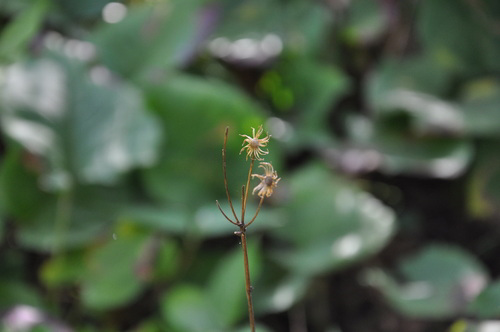
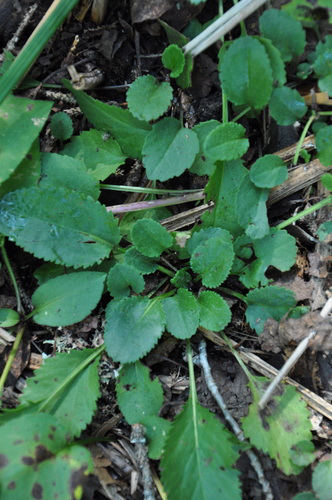
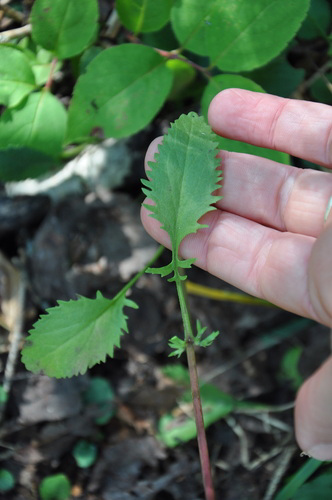
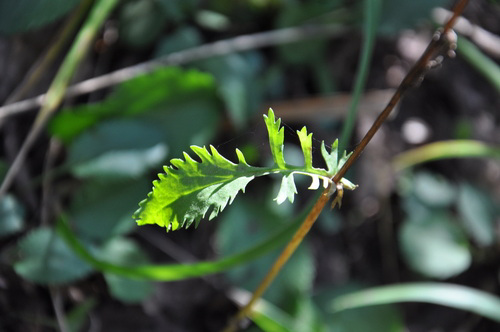
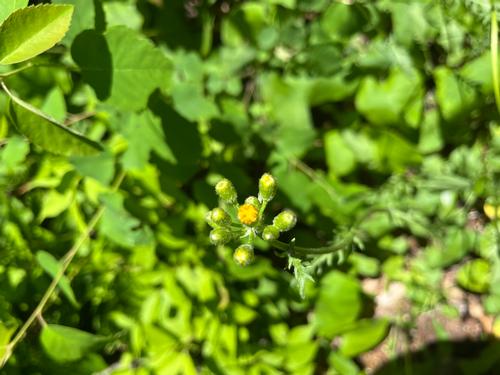
An erect, herbaceous perennial with low overwintering buds that arise singly from adventitious root shoots and short rhizozomes. Basal leaves are simple with truncated bases, while basal rosette leaves are medium to dark green with potentially splotchy purple coloration on underside of leaves and cobwebby pubescence on both leaf surfaces that becomes glabrous with age. The prominent basal leaves and caline leaf size reducing near inflorescence are the two characteristics that separate this plant from others similar species.
Status and Rank
US Status: No Status/Not Listed
State Status: T - Threatened (legally protected)
Global Rank: G1 - Critically imperiled
State Rank: S1 - Critically imperiled
Occurrences
| County | Number of Occurrences | Year Last Observed |
|---|---|---|
| Keweenaw | 1 | 2024 |
Information is summarized from MNFI's database of rare species and community occurrences. Data may not reflect true distribution since much of the state has not been thoroughly surveyed.
Habitat
Known from only one occurrence on Isle Royale in dry-mesic northern forest within a volcanic bedrock glade complex of rocky openings; close to large, north-facing volcanic cliff. Found in light shade and on thin, calcium-rich soils over greenstone.
Natural Community Types
For each species, lists of natural communities were derived from review of the nearly 6,500 element occurrences in the MNFI database, in addition to herbarium label data for some taxa. In most cases, at least one specimen record exists for each listed natural community. For certain taxa, especially poorly collected or extirpated species of prairie and savanna habitats, natural community lists were derived from inferences from collection sites and habitat preferences in immediately adjacent states (particularly Indiana and Illinois). Natural communities are not listed for those species documented only from altered or ruderal habitats in Michigan, especially for taxa that occur in a variety of habitats outside of the state.
Natural communities are not listed in order of frequency of occurrence, but are rather derived from the full set of natural communities, organized by Ecological Group. In many cases, the general habitat descriptions should provide greater clarity and direction to the surveyor. In future versions of the Rare Species Explorer, we hope to incorporate natural community fidelity ranks for each taxon.
Associated Plants
Balsam fir (Abies balsamea), serviceberry (Amelanchier spp.), spreading dogbane (Apocynum androsaemifolium), wild sarsaparilla (Aralia nudicaulis), harebell (Campanula rotundifolia), northern paintbrush (Castilleja septentrionalis), ram’s head lady-slipper (Cypripedium arietinum), poverty grass (Danthonia spicata), bush-honeysuckle (Diervilla lonicera), large-leaved aster (Eurybia macrophylla), wild strawberry (Fragaria virginiana), spurred gentian (Halenia deflexa), round-lobed hepatica (Hepatica americana), Canada hawkweed (Hieracium kalmii), glaucus honeysuckle (Lonicera dioica), wild lily-of-the-valley (Maianthemum canadense), cow-wheat (Melampyrum lineare), one-sided pyrola (Orthilia secunda), rough-leaved rice-grass (Oryzopsis asperifolia), white spruce (Picea glauca), quaking aspen (Populus tremuloides), thimbleberry (Rubus parviflorus), and northern heart-leaved aster (Symphyotrichum ciliolatum).
Management Recommendations
Currently known from a single population, making extinction of the species highly probable due to a single disturbance event. Survey similar habitat in Isle Royale archipelago for more populations. Monitor nearby trail frequently for invasive species establishment and population for significant herbivory. Continue enforcing National Park rules and regulations restricting camping and fire. Do not build new trails closer to the population. Suppress high-intensity wildfire.
Survey Methods
Random meander search covers areas that appear likely to have rare taxa, based on habitat and the judgment of the investigator.
-
Meander Search
-
Survey Period: From third week of June to second week of July
-
References
Technical References
- Catling, P. M. 2015. Osmia species (Megachilidae) pollinate Cypripedium parviflorum (Orchidaceae) and Packera paupercula (Asteraceae): A localized case of Batesian mimicry? Canadian Field-naturalist 129: 38–44.
- Di Capua, G. and S. Rahmstorf. 2023. Extreme weather in a changing climate. Environmental Research Letters 18: 102001.
- Jepson Flora Project. 2026. Jepson eFlora, <https://ucjeps.berkeley.edu/eflora/>. Accessed 19 Feb 2026.
- Kowal, R., E. Judziewicz, and J. Edwards. 2011. Isle Royale ragwort (Asteraceae, Senecioneae), a new species endemic to Isle Royale, Michigan, U.S.A. Brittonia 63: 343-354.
- Michigan Natural Features Inventory (MNFI). 2026. Michigan Natural Heritage Database, Lansing, Michigan, USA.
- NatureServe. 2026. NatureServe Network Biodiversity Location Data accessed through NatureServe Explorer <https://explorer.natureserve.org/>. Accessed 04 Jan 2026.
- Pelser, P. B., B. Nordenstam, J. W. Kadereit, and L. E. Watson. 2007. An ITS phylogeny of tribe Senecioneae (Asteraceae) and a new delimitation of Senecio L. Taxon 56: 1077–1104.
- Reznicek, A. A., E. G. Voss, and B. S. Walters. 2026. Michigan Flora Online. University of Michigan <https://michiganflora.net/>. Accessed 09 Jan 2026.
- Stevens, P. F. 2026. Angiosperm Phylogeny Website. <https://www.mobot.org/mobot/research/apweb>. Version 13. Accessed 03 Jan 2026.
- Trock, D. K. 2003. The genus Packera (Asteraceae: Senicioneae) in Colorado, U.S.A. SIDA, Contributions to Botany 20: 1023-1041.
- Voss, E. G. 1996. Michigan Flora, Part III Dicots (Pyrolaceae-Compositae). Cranbrook Institute of Science, Bulletin 61 and University of Michigan Herbarium. Regents of the University of Michigan, Ann Arbor, Michigan, USA.
- Xue, P., X. Ye, J. S. Pal, P. Y. Chu, M. B. Kayastha, and C. Huang. 2022. Climate projections over the Great Lakes Region: using two-way coupling of a regional climate model with a 3-D lake model. Geoscientific Model Development 15:4425–4446.