Michigan Bat Roost Monitoring Program
There is a current lack of understanding of the basic biology and ecology of bats that is placing great limitations on their conservation efforts in Michigan. The Michigan Bat Roost Monitoring Program (MBRMP) was developed in partnership with the Michigan Natural Features Inventory and the Michigan Department of Natural Resources to improve our understanding of bat roosting ecology across the state. Bats have been facing numerous novel threats in recent years and, to help protect them from these threats, we need to know when and where they are roosting. The MBRMP is looking for community scientists who are interested in monitoring roosting bats on their property or on public land to provide us with information about their roost sites and the bats that are using them. This information will be used to inform bat conservation across the state.
Report a Bat Roost

Scan for the
Roost Submission Form
on a mobile device
We are looking for roost locations to help us understand where and when bats are roosting across the state. If you have seen bats roosting on your property or on public land, please consider reporting the roost to the Michigan Bat Roost Monitoring Program to help inform bat conservation efforts in Michigan. Photos of both the roost and bats are helpful; however, observers should avoid getting too close or disturbing the bats.
Roost definition: structures that bats use to rest during the day, between bouts of feeding at night, and/or to hibernate through the winter. Depending on the species of bat and time of year, they will gather in small or large numbers and will utilize many different structures as roost sites, including human-made structures such as sheds, attics, and barns. Day roosts are roost sites that bats use to rest during the day. Night roosts, on the other hand, are warm, protected areas that they use to rest during the night between bouts of feeding. Night roosts are usually on open structures such as the side of a building or under a bridge. Hibernacula (winter roosts) are locations of stable temperature and humidity that allow hibernating bats to survive the winter. Bats often use mines and caves as hibernacula in Michigan, however some bats (especially big brown bats) will overwinter in buildings.
Perform Emergence Counts
If you have reported a roost and would like to provide more information, we would greatly appreciate emergence counts of your roost site(s). Emergence counts are simple and involve sitting outside near a roost in the evening and counting the number of bats as they emerge. These counts allow us to estimate the number of bats using a roost and help us to understand fluctuations in bat populations over time.
If possible, we would appreciate at least two emergence counts at each roost site – one in June and one in late July, but more or fewer emergence counts are also greatly appreciated.
General guidelines to keep the emergence counts standardized
- Try to perform the emergence counts on evenings when temperatures are above 60ºF, there is no rain, and wind speeds are no higher than 12 mph.
- Determine the roost exit(s) by looking for discolored areas in/around chimneys, eaves, and soffits as well as piles of guano. You may need helpers to cover all exits if there are multiple.
- Begin your emergence count 30 minutes before sunset and continue until one hour after sunset (or until it is too dark to see bats emerging).
- Position yourself (and any helpers) for easy viewing of bats exiting. It is best to have the bats silhouetted against the sky for easy viewing. Do not shine lights into the roost to count the bats. Too much disturbance from lights and activity can cause them to abandon the roost.
- Count the bats as they exit. Some may re-enter the roost, especially when there are pups inside. Try to keep track of this if possible.
Additional Resources
 Joy and Richard Kuyt
Roost Monitoring Packet
 Mary and Shawn McNichol
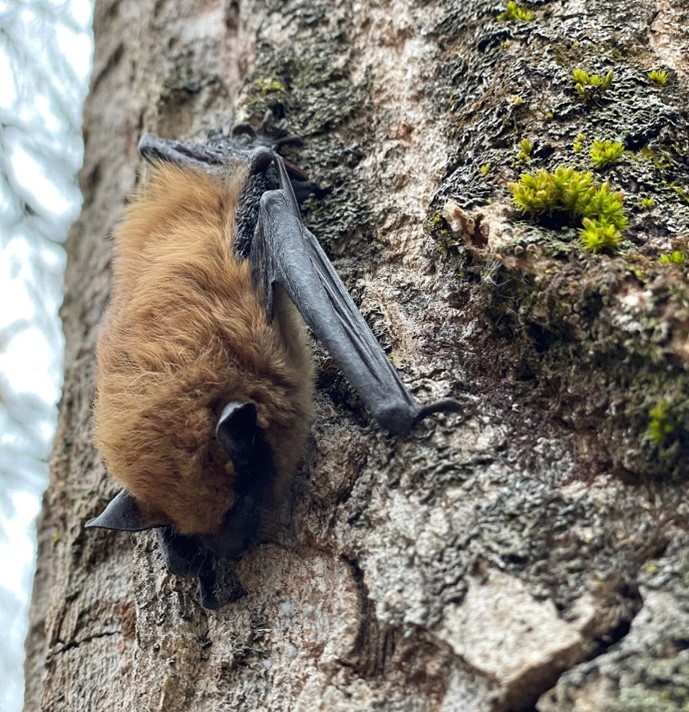 Leah Riley/USFWS
ESA Compliance for Listed Bats
Contacts
Nicolette Sexton (sextonn4@msu.edu) – Reporting and tech-related questions
John DePue, DNR (DePueJ1@michigan.gov) – State listed/general bat questions
USFWS MI Ecological Services Field Office (EastLansing@fws.gov) – Federally listed/general bat questions
Michigan's Listed Bats