

Plants and Animals
Wolffiella gladiata Flordia mudmidget
Key Characteristics
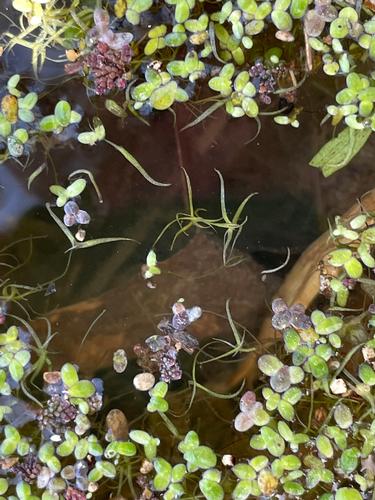
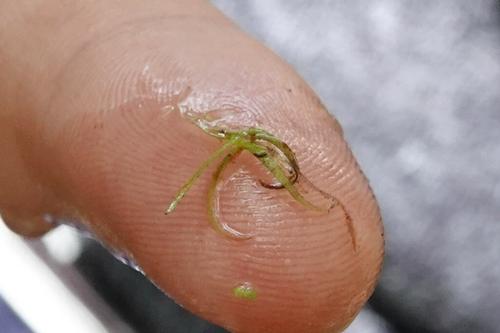
The whole body of the plant consists of a single, sword or scythe–shaped frond that lacks leaves, stems, and roots and rarely flowers. The frond is linear or needle-like and ranges from 3–9 mm (0.1–0.4 in) long and less than 1 mm (0.04 in) wide. It can be found as a single frond, but often fronds are found cohered in clumps that appear to originate from a single base. These clumps become hemispherical as they increase in size, which can resemble a mop head or jellyfish dangling below the water’s surface. The clumps then cling together to form floating mats. Florida mudmidget can be distinguished from other duckweeds by its simple, linear frond and lack of roots. It is much larger and longer than species of Wolffia, which are the only other duckweeds that lacks roots (Reznicek et. al. 2011). Star duckweed (Lemna trisulca) is the most likely to be confused for Florida mudmidget as it also forms underwater, interconnected clumps, but the frond differs in shape.
Status and Rank
US Status: No Status/Not Listed
State Status: T - Threatened (legally protected)
Global Rank: G4G5 - Rank is uncertain, ranging from apparently secure to secure
State Rank: SNR - Not ranked
Occurrences
| County | Number of Occurrences | Year Last Observed |
|---|
Information is summarized from MNFI's database of rare species and community occurrences. Data may not reflect true distribution since much of the state has not been thoroughly surveyed.
Habitat
Florida mudmidget occurs in shaded, sheltered, shallow bodies of water, or along shorelines, often with other duckweeds. The Michigan population was discovered in a mucky-bottomed seepage lake. It also occurs in nearby northwest Indiana where populations occurred in shallow pools near the shores of lakes as well as shaded ponds.
Natural Community Types
For each species, lists of natural communities were derived from review of the nearly 6,500 element occurrences in the MNFI database, in addition to herbarium label data for some taxa. In most cases, at least one specimen record exists for each listed natural community. For certain taxa, especially poorly collected or extirpated species of prairie and savanna habitats, natural community lists were derived from inferences from collection sites and habitat preferences in immediately adjacent states (particularly Indiana and Illinois). Natural communities are not listed for those species documented only from altered or ruderal habitats in Michigan, especially for taxa that occur in a variety of habitats outside of the state.
Natural communities are not listed in order of frequency of occurrence, but are rather derived from the full set of natural communities, organized by Ecological Group. In many cases, the general habitat descriptions should provide greater clarity and direction to the surveyor. In future versions of the Rare Species Explorer, we hope to incorporate natural community fidelity ranks for each taxon.
Associated Plants
Yellow pond-lily (Nuphar advena), swamp beggar-ticks (Bidens discoidea), coontail (Ceratophyllum demersum), spiny hornwort (Ceratophyllum echinatum), buttonbush (Cephalanthus occidentalis), whorled loosestrife (Decodon verticillatus), sweet-scented waterlily (Nymphaea odorata), mild water-pepper (Persicaria hydropiperoides), pondweed (Potamogeton strictifolius), pointed water meal Wolffia brasiliensis, and common water meal (Wolffia columbiana).
Management Recommendations
A status survey for this species is warranted to better understand its extent and habitat requirements in Michigan. This species requires conservation of shaded, slowmoving water bodies, regulation of nutrient inputs, and protection of hydrological regimes.
Survey Methods
Random meander search covers areas that appear likely to have rare taxa, based on habitat and the judgment of the investigator.
-
Meander Search
-
Survey Period: From first week of April to first week of November
-
References
Survey References
- Elzinga, C.L., D.W. Salzer, and J.W. Willoughby. 1998. Measuring and Monitoring Plant Populations. The Nature Conservancy and Bureau of Land Management, Denver. BLM Technical Reference 1730-1. 477pp.
- Goff, G.F., G.A. Dawson, and J.J. Rochow. 1982. Site examination for Threatened and Endangered plant species. Environmental Management 6(4): 307-316
- Nelson, J.R. 1984. Rare Plant Field Survey Guidelines. In: J.P. Smith and R. York. Inventory of rare and endangered vascular plants of California. 3rd Ed. California Native Plant Society, Berkeley. 174pp.
- Nelson, J.R. 1986. Rare Plant Surveys: Techniques For Impact Assessment. Natural Areas Journal 5(3):18-30.
- Nelson, J.R. 1987. Rare Plant Surveys: Techniques for Impact Assessment. In: Conservation and management of rare and endangered plants. Ed. T.S. Elias. California Native Plant Society, Sacramento. 8pp.
Technical References
- Alix, M.S. and R.W. Scribailo. 2001. Rediscovery of Wolffiella gladiata (Lemnaceae) in Indiana. The Great Lakes Botanist 40(1): 17.
- Edelman, M., K. Appenroth, K.S. Sree, and T. Oyama. 2022. Ethnobotanical History: Duckweeds in Different Civilizations. Plants 11(2124): 1-21.
- Godfrey, R.K. and Wooten. 1979. Aquatic and Wetland Plants of Southeastern United States. Monocotyledons. University of Georgia Press, Athens. 933pp.
- Kurz, K. and D. Crowson. 1949. The Flowers of Wolffiella floridana (J. D. SM.) Thompson. Quarterly Journal of the Florida Academy of Sciences 11(4): 87-98.
- NatureServe. 2023. NatureServe Network Biodiversity Location Data accessed through NatureServe Explorer Web. <https://explorer.natureserve.org/>. Accessed 3 March, 2025.
- Pozzi, C. M., V. F. Brambilla, A. Gaiti, and A. Spada. 2024. Plant Developmental Oddities. Planta 260(4): 1-20.
- Reznicek, A. A., E. G. Voss, and B. S. Walters. 2011. Michigan Flora Online. University of Michigan. Web. <https://michiganflora.net/>. Accessed 31 March 2025.
- Smith, K. E., M. Zhou, P. Flis, D. H. Jones, A. Bishopp, and L. Yant. 2024. The Evolution of the Duckweed Ionome Mirrors Losses in Structural Complexity. Annals of Botany 133: 997-1006.
- Stevens, P. F. 2017. Angiosperm Phylogeny Website, Version 14. <www.mobot.org/mobot/research/apweb/>. Accessed 31 March 2025.
- Thompson, H. T. 1896. The Ligulate Wolffias of the United States. Missouri Botanical Garden Press: 101-111.
- Tippery, N. P., D. H. Les, K. J. Appenroth, K. S. Sree, D. J. Crawford, and M. Bog. 2021. Lemnaceae and Orontiaceae Are Phylogenetically and Morphologically Distinct from Araceae. Plants 10(12): 1-20.
- U.S.A., Michigan. Berrien County, 2018. Namestnik, S. and B. Slaughter. (MICH [MICH1559236]).
- Wilhelm, G. and L. Rericha. 2017. Flora of the Chicago Region: A Floristic and Ecological Synthesis. Indiana Academy of Science, Indianapolis, IN.
- Ziegler, P., K. J. Appenroth, and K. S. Sree. 2023. Survival Strategies of Duckweeds, the World’s Smallest Angiosperms. Plants 12(11): 1-30.