

Plants and Animals
Carex viridistellata Greenstar sedge
Key Characteristics
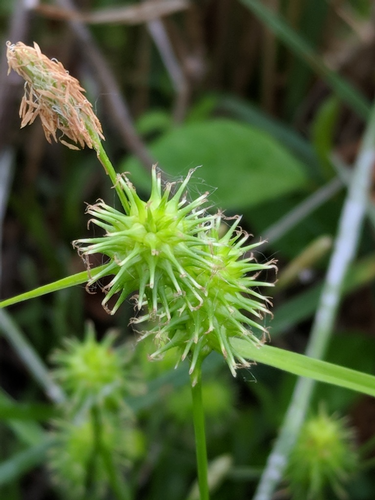
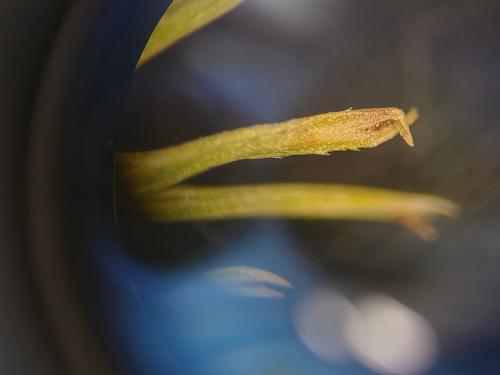
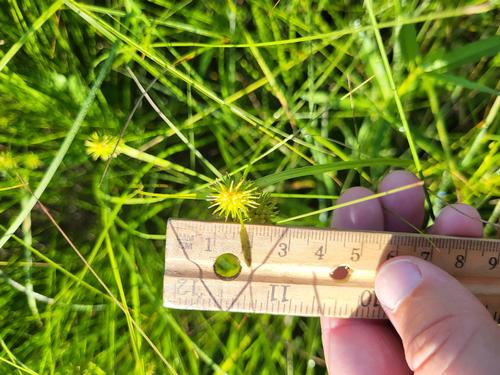
Carex viridistellata is a robust, clumping sedge with short-to-round cylindrical pistillate spikes 10.5–14 mm (4.1-5.5 in) wide with reflexed perigynia at the bottom of the spike. Unlike similar sedges, C. viridistellata has pistillate scales with one central green nerve with wide white or transparent margins and are obscured by the perigynia thus effectively invisible and occasionally serrate beak edges on the perigynia.
Status and Rank
US Status: No Status/Not Listed
State Status: T - Threatened (legally protected)
Global Rank: G2G3 - Rank is uncertain, ranging from imperiled to vulnerable
State Rank: SNR - Not ranked
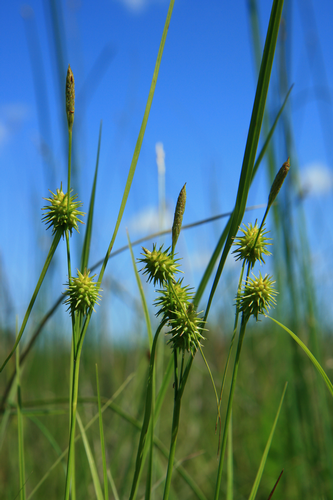
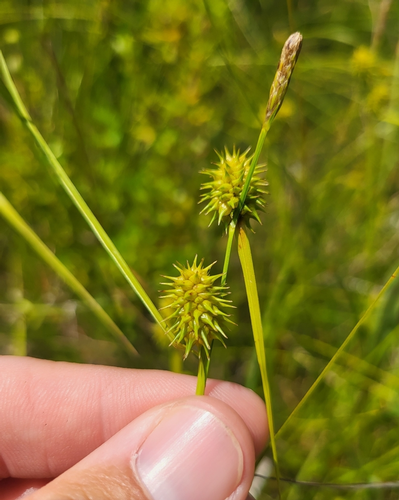
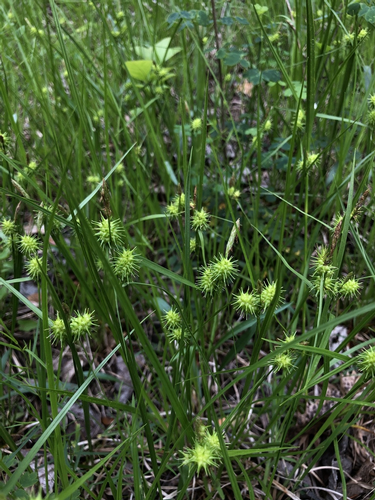
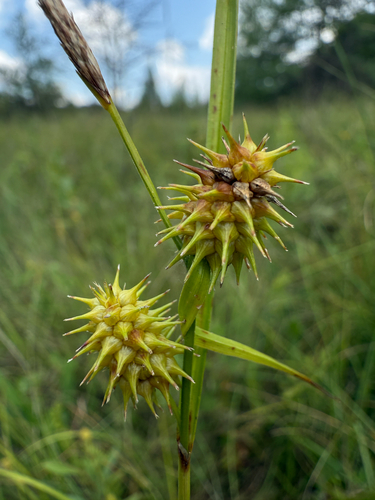
Occurrences
| County | Number of Occurrences | Year Last Observed |
|---|---|---|
| Jackson | 1 | 2023 |
Information is summarized from MNFI's database of rare species and community occurrences. Data may not reflect true distribution since much of the state has not been thoroughly surveyed.
Habitat
Across its range, Carex viridistellata is found in wetlands, with open sun, and at some sites is locally abundant, but in Michigan known populations are mostly restricted to high-quality prairie fens but can be found rarely in wet-mesic to wet lakeplain prairies often in wet, marly and sandy openings, open sedge meadow and calcareous seeps within fen complexes.
Natural Community Types
For each species, lists of natural communities were derived from review of the nearly 6,500 element occurrences in the MNFI database, in addition to herbarium label data for some taxa. In most cases, at least one specimen record exists for each listed natural community. For certain taxa, especially poorly collected or extirpated species of prairie and savanna habitats, natural community lists were derived from inferences from collection sites and habitat preferences in immediately adjacent states (particularly Indiana and Illinois). Natural communities are not listed for those species documented only from altered or ruderal habitats in Michigan, especially for taxa that occur in a variety of habitats outside of the state.
Natural communities are not listed in order of frequency of occurrence, but are rather derived from the full set of natural communities, organized by Ecological Group. In many cases, the general habitat descriptions should provide greater clarity and direction to the surveyor. In future versions of the Rare Species Explorer, we hope to incorporate natural community fidelity ranks for each taxon.
Associated Plants
Associated species from Michigan collections include Arnoglossum plantagineum (prairie Indian-plantain), Carex aquatilis (water sedge), C. lasiocarpa (wiregrass sedge), C. sterilis (dioecious sedge), C. stricta (tussock sedge), Cephalathus occidentalis (buttonbush), Cladium mariscoides (twig-rush), Cornus spp. (dogwood), Dasiphora fruticosa (shrubby cinquefoil), Eleocharis rostellata (spike-rush), Eupatorium perfoliatum (boneset), Eutrochium maculatum (Joe-pye weed), Liatris spicata (marsh blazing-star), Populus tremuloides (quaking aspen), Schoenoplectus spp. (bulrush), Solidago ohioensis (Ohio goldenrod), Thelypteris palustris (marsh fern), Toxicodendron vernix (poison sumac), and Typha latifolia (broad-leaved cat-tail).
Management Recommendations
Relatively newly described species and full extent in Michigan is unknown; this species can be easily overlooked and would benefit from surveys for new populations in suitable habitat. Maintain natural disturbance and hydrological regimes. This species likely requires open conditions. Prevent woody plant encroachment by using prescribed fire or manual brush removal. Much of this habitat has been lost and degraded via conversion to agriculture, development, alterations of hydrology via drains, and fire suppression. Habitat could also be degraded from hydrological alterations in groundwater recharge area miles away (e.g., gravel mines). Vulnerable to ORV impacts and dredging and filling of sites.
Survey Methods
Random meander search covers areas that appear likely to have rare taxa, based on habitat and the judgment of the investigator.
-
Meander Search
-
Survey Period: From third week of July to fourth week of September
-
References
Survey References
- Elzinga, C.L., D.W. Salzer, and J.W. Willoughby. 1998. Measuring and Monitoring Plant Populations. The Nature Conservancy and Bureau of Land Management, Denver. BLM Technical Reference 1730-1. 477pp.
- Goff, G.F., G.A. Dawson, and J.J. Rochow. 1982. Site examination for Threatened and Endangered plant species. Environmental Management 6(4): 307-316
- Nelson, J.R. 1984. Rare Plant Field Survey Guidelines. In: J.P. Smith and R. York. Inventory of rare and endangered vascular plants of California. 3rd Ed. California Native Plant Society, Berkeley. 174pp.
- Nelson, J.R. 1986. Rare Plant Surveys: Techniques For Impact Assessment. Natural Areas Journal 5(3):18-30.
- Nelson, J.R. 1987. Rare Plant Surveys: Techniques for Impact Assessment. In: Conservation and management of rare and endangered plants. Ed. T.S. Elias. California Native Plant Society, Sacramento. 8pp.
Technical References
- [MDNR] Michigan Department of Natural Resources. In press. Michigan’s Wildlife Action Plan 2025-2035. Michigan Department of Natural Resources, Lansing, MI. <https://www.michigan.gov/dnrwildlifeactionplan>.
- Britton, N.L. 1907. Manual of the Flora of the Northern States and Canada. 3rd ed. Henry Holt and Company, New York, New York, USA. Available at: http://hdl.handle.net/2027/nyp.33433010726937.
- Derieg, N. J., A. Sangaumphai, and L. P. Bruederle. 2008. Genetic diversity and endemism in North American Carex Section Ceratocystis (Cyperaceae). American Journal of Botany 95(10):1287–1296.
- Derieg, N. J., S. J. Weil, A. A. Reznicek, L. P. Bruederle. 2013. Carex viridistellata sp. nov. (Cyperaceae), A New Cryptic Species from Prairie Fens of the Eastern United States. Systematic Botany 38(1):82–91.
- Reznicek, A. A. 1990. Evolution in Sedges (Carex, Cyperaceae). Canadian Journal of Botany 68(7):1409-1432.
- Reznicek, A. A., E. G. Voss, and B. S. Walters. 2026. Michigan Flora Online. University of Michigan. <https://michiganflora.net>. Accessed 19 Feb 2026.
- Voss, E. G., and A. A. Reznicek. 2012. Field Manual of Michigan Flora. University of Michigan Press, Ann Arbor, Michigan, USA. 990 pp.