

Plants and Animals
Solidago vossii Voss's goldenrod
Key Characteristics
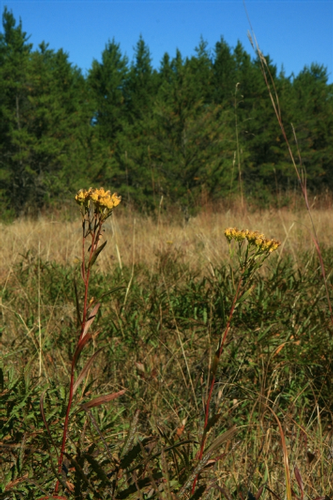
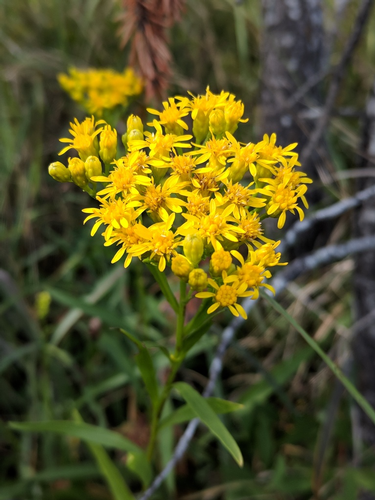
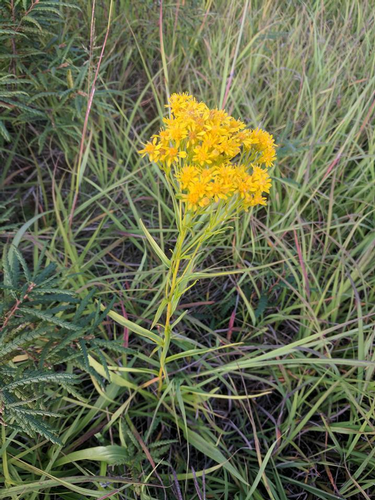
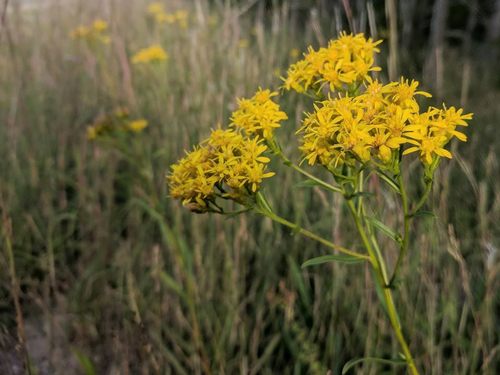
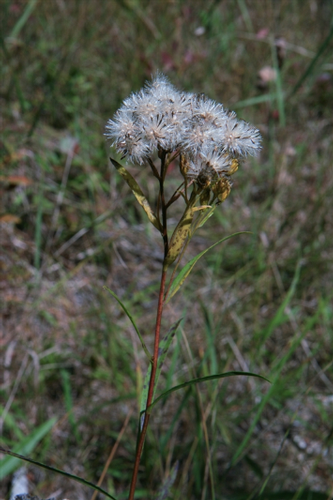
An erect perennial herb, with stiff stems 50-80 cm tall, arising singly from a thickened, branching basal rootstock structure. Basal leaf margins are sparsely to regularly serrulate and each tooth appressed and ending in a gland with acute leaf tips. The flowering heads are terminal, approximately 20–60 heads per plant, flat-topped or convexed.
Status and Rank
US Status: LT - Listed Threatened
State Status: E - Endangered (legally protected)
Global Rank: G1 - Critically imperiled
State Rank: S1 - Critically imperiled
Occurrences
| County | Number of Occurrences | Year Last Observed |
|---|---|---|
| Crawford | 2 | 2021 |
| Kalkaska | 2 | 2021 |
Information is summarized from MNFI's database of rare species and community occurrences. Data may not reflect true distribution since much of the state has not been thoroughly surveyed.
Habitat
Michigan hosts the only known global occurrence in the Northern Lower Peninsula, usually in seasonally inundated sandy glacial outwash plains and old interdunal depressions on wet-mesic sand prairie habitat within jack pine barrens.
Natural Community Types
For each species, lists of natural communities were derived from review of the nearly 6,500 element occurrences in the MNFI database, in addition to herbarium label data for some taxa. In most cases, at least one specimen record exists for each listed natural community. For certain taxa, especially poorly collected or extirpated species of prairie and savanna habitats, natural community lists were derived from inferences from collection sites and habitat preferences in immediately adjacent states (particularly Indiana and Illinois). Natural communities are not listed for those species documented only from altered or ruderal habitats in Michigan, especially for taxa that occur in a variety of habitats outside of the state.
Natural communities are not listed in order of frequency of occurrence, but are rather derived from the full set of natural communities, organized by Ecological Group. In many cases, the general habitat descriptions should provide greater clarity and direction to the surveyor. In future versions of the Rare Species Explorer, we hope to incorporate natural community fidelity ranks for each taxon.
Associated Plants
Big bluestem (Andropogon girardii), blue joint-grass (Calamagrostis canadensis), indian paintbrush (Castilleja coccinea), sedges (Carex conoidea and Carex flava), leatherleaf (Chamaedaphne calyculata), sweetfern (Comptonia peregrina), shrubby cinquefoil (Dasiphora fruiticosa), round-leaved sundew (Drosera rotundifolia), golden-seeded spike rush (Eleocharis elliptica), long-leaved bluets (Houstonia longifolia), wild blue flag (Iris versicolor), pale spike lobelia (Lobelia spicata), marsh wild-Timothy (Muhlenbergia glomerata), jack pine (Pinus banksiana), red pine (Pinus resinosa), sand cherry (Prunus pumila), meadowsweet (Spiraea alba), nodding ladies’-tresses (Spiranthes cernua), mountain blue-eyed-grass (Sisyrinchium montanum), rough-leaved goldenrod (Solidago rugosa), and low sweet blueberry (Vaccinium angustifolium).
Management Recommendations
Manage to maintain intact wet-mesic prairie and surrounding Jack pine barrens, likely with prescribed burn and/or woody plant management. Manage for invasive plant species that threaten species. Restrict ATV usage.
Survey Methods
Random meander search covers areas that appear likely to have rare taxa, based on habitat and the judgment of the investigator.
-
Meander Search
-
Survey Period: From second week of August to fourth week of October
-
References
Survey References
- Elzinga, C.L., D.W. Salzer, and J.W. Willoughby. 1998. Measuring and Monitoring Plant Populations. The Nature Conservancy and Bureau of Land Management, Denver. BLM Technical Reference 1730-1. 477pp.
- Goff, G.F., G.A. Dawson, and J.J. Rochow. 1982. Site examination for Threatened and Endangered plant species. Environmental Management 6(4): 307-316
- Nelson, J.R. 1984. Rare Plant Field Survey Guidelines. In: J.P. Smith and R. York. Inventory of rare and endangered vascular plants of California. 3rd Ed. California Native Plant Society, Berkeley. 174pp.
- Nelson, J.R. 1986. Rare Plant Surveys: Techniques For Impact Assessment. Natural Areas Journal 5(3):18-30.
- Nelson, J.R. 1987. Rare Plant Surveys: Techniques for Impact Assessment. In: Conservation and management of rare and endangered plants. Ed. T.S. Elias. California Native Plant Society, Sacramento. 8pp.
Technical References
- Cohen, J. G., M. A. Kost, B. S. Slaughter, D. A. Albert, J. M. Lincoln, A. P. Kortenhoven, C. M. Wilton, H. D. Enander, and K. M. Korroch. 2020. Michigan Natural Community Classification [web application]. Michigan Natural Features Inventory, Michigan State University Extension, Lansing, MI. Accessed 30 Dec 2025.
- Laureto, P. J., and J. S. Pringle. 2010. Solidago vossii (Asteraceae), a new species of Goldenrod from northern Michigan. The Michigan Botanist 49: 105-117.
- Michigan Natural Features Inventory (MNFI). 2026. Michigan Natural Heritage Database, Lansing, Michigan, USA.
- NatureServe. 2026. NatureServe Network Biodiversity Location Data accessed through NatureServe Explorer <https://explorer.natureserve.org/>. Accessed 04 Jan 2026.
- Penskar, M. R., P. J. Higman, and S. R. Crispin. 1996. Special plant abstract for Solidago houghtonii (Houghton’s goldenrod). Michigan Natural Features Inventory, Lansing, MI. 3 pp.
- Reznicek, A. A., E. G. Voss, and B. S. Walters. 2026. Michigan Flora Online. University of Michigan <https://michiganflora.net/>. Accessed 09 Dec 2025.