

Plants and Animals
Myosotis verna White forget-me-not
Key Characteristics
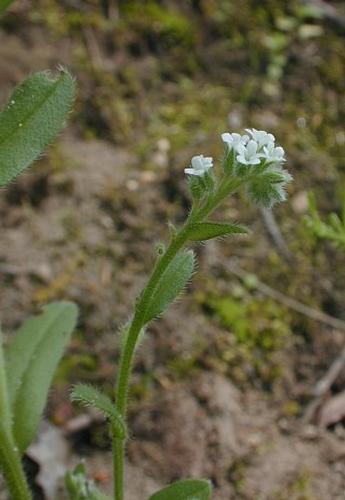
An erect annual with a fibrous taproot ranging in from 5–40 cm. Stems are round, slender, and covered in white hairs. Leaves are alternate, simple, and sessile, 1–5 cm long and 0.2–1 cm wide, oblong with blunt tips and covered with stiff hairs. The sepals are 4–7 mm long and fruit is a schizocarp splitting into four compressed nutlets 1.2–1.5 mm long.
Myositis verna can be distinguished from other Myosis species by their smaller nutlets and flowers that are usually spaced less than 1 cm apart along their stem.
Status and Rank
US Status: No Status/Not Listed
State Status: SC - Special Concern (rare or uncertain; not legally protected)
Global Rank: G5 - Secure
State Rank: SNR - Not ranked
Occurrences
| County | Number of Occurrences | Year Last Observed |
|---|
Information is summarized from MNFI's database of rare species and community occurrences. Data may not reflect true distribution since much of the state has not been thoroughly surveyed.
Habitat
Known occurrences in Michigan are primarily in southeastern Lower Peninsula, and one county in the Upper Peninsula. Grows in a variety of open and semi-open environments including dry to mesic woodlands, upland open woodlands, barren wooded slopes, sandy savannas, sand and tall grass prairies. Ultimately favoring dry habitats and areas with well-drained soil M. verna have been known to occasionally be found in areas along stream banks, and seasonally moist lowlands.
Natural Community Types
For each species, lists of natural communities were derived from review of the nearly 6,500 element occurrences in the MNFI database, in addition to herbarium label data for some taxa. In most cases, at least one specimen record exists for each listed natural community. For certain taxa, especially poorly collected or extirpated species of prairie and savanna habitats, natural community lists were derived from inferences from collection sites and habitat preferences in immediately adjacent states (particularly Indiana and Illinois). Natural communities are not listed for those species documented only from altered or ruderal habitats in Michigan, especially for taxa that occur in a variety of habitats outside of the state.
Natural communities are not listed in order of frequency of occurrence, but are rather derived from the full set of natural communities, organized by Ecological Group. In many cases, the general habitat descriptions should provide greater clarity and direction to the surveyor. In future versions of the Rare Species Explorer, we hope to incorporate natural community fidelity ranks for each taxon.
Associated Plants
Serviceberry (Amelanchier sp.), marsh bellflower (Campanula aparinoides), flat-topped white aster (Doellingeria umbellata), Robin’s plantain (Erigeron pulchellus), soapwort gentian (Gentiana saponaria), common frostweed (Helianthemum canadense), round-headed bush clover (Lespedeza capitata), common wood rush (Luzula multiflora), false Solomons seal (Maianthemum racemosa), Jack pine (Pinus banksiana), oak sp. (Quercus sp.), white clover (Trifolium repens).
Management Recommendations
Status surveys for this species is warranted to better understand its extent and habitat requirements in Michigan. This species is threatened by invasive species, woody encroachment, and conversion of open communities to forests through canopy closure. Likely requires management that maintains openings, and optimal management would include prescribed burns to perpetuate open habitats and forest edges. However, since growth commences early in the season, late spring burns should be avoided. Maintenance of openings via other means (mechanical tree and shrub removal) are recommended where necessary.
Survey Methods
Random meander search covers areas that appear likely to have rare taxa, based on habitat and the judgment of the investigator.
-
Meander Search
-
Survey Period: From third week of May to second week of June
-
References
Survey References
- Elzinga, C.L., D.W. Salzer, and J.W. Willoughby. 1998. Measuring and Monitoring Plant Populations. The Nature Conservancy and Bureau of Land Management, Denver. BLM Technical Reference 1730-1. 477pp.
- Goff, G.F., G.A. Dawson, and J.J. Rochow. 1982. Site examination for Threatened and Endangered plant species. Environmental Management 6(4): 307-316
- Nelson, J.R. 1984. Rare Plant Field Survey Guidelines. In: J.P. Smith and R. York. Inventory of rare and endangered vascular plants of California. 3rd Ed. California Native Plant Society, Berkeley. 174pp.
- Nelson, J.R. 1986. Rare Plant Surveys: Techniques For Impact Assessment. Natural Areas Journal 5(3):18-30.
- Nelson, J.R. 1987. Rare Plant Surveys: Techniques for Impact Assessment. In: Conservation and management of rare and endangered plants. Ed. T.S. Elias. California Native Plant Society, Sacramento. 8pp.
Technical References
- Al-Shehbaz, Ihsan A. 1991. The Genera of Boraginaceae in the Southeastern United States. Journal of the Arnold Arboretum, 1: 60-161. https://doi.org/10.5962/p.315943.
- Gleason, H. A., and A. Cronquist. 1991. Manual of Vascular Plants of Northeastern United States and Adjacent Canada. 2nd Ed. The New York Botanical Garden, New York, New York.
- Hilty, J. 2020. Spring Scorpion Grass. Illinois Wildflowers. Accessed 19 Mar 2026. https://www.illinoiswildflowers.info/woodland/plants/spr_scorpion.htm.
- NatureServe. 2026. NatureServe Explorer [web application]. NatureServe, Arlington, Virginia. Available https://explorer.natureserve.org/pro/. Accessed: 19 March 2026).
- Reznicek, A. A. 1962. Review of The Flora of Manitoulin Island. The Michigan Botanist 24: 76. https://www.biodiversitylibrary.org/page/60945306.
- Yatskievych, G. 2006. Steyermark’s Flora of Missouri, Volume 2. Missouri Botanical Garden Press, St. Louis, MO.