

Plants and Animals
Hypericum swinkianum Swink's St. John's-wort
Key Characteristics
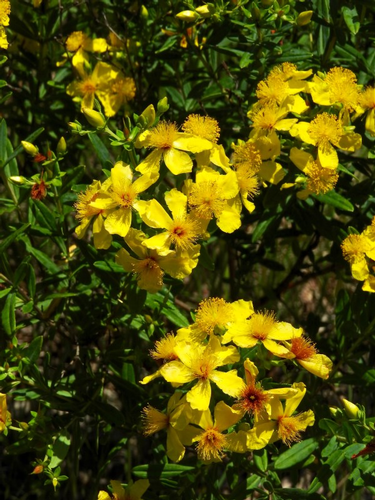
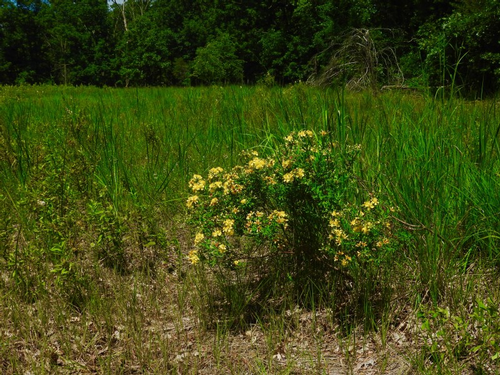
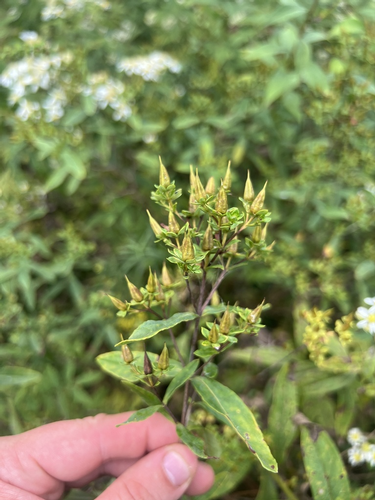
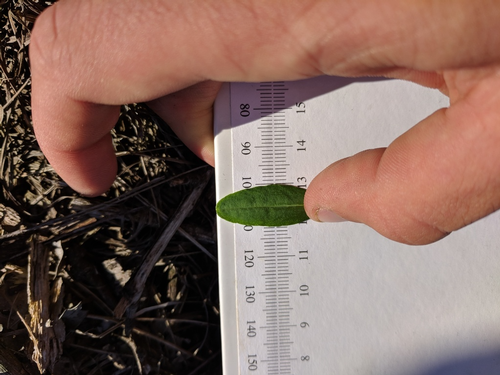
Showy shrub growing up to 2 meters in height; foliage dark and sleek, 10.5 to 15 mm wide; branches terminated by showy yellow flowers arranged in compound dichasia with 15+ blooms per inflorescence; produces five-parted seed-bearing capsules.
Status and Rank
US Status: No Status/Not Listed
State Status: SC - Special Concern (rare or uncertain; not legally protected)
Global Rank: GNR - Not ranked
State Rank: SNR - Not ranked
Occurrences
| County | Number of Occurrences | Year Last Observed |
|---|---|---|
| Allegan | 3 | 2025 |
| Mackinac | 1 | 2023 |
Information is summarized from MNFI's database of rare species and community occurrences. Data may not reflect true distribution since much of the state has not been thoroughly surveyed.
Habitat
Known occurrences in Michigan come primarily from sandy counties adjacent to Lake Michigan; usually found in open, sandy environments, sometimes including roadsides, spanning a number of natural communities; adequate soil moistures range from mesic to wet.
Natural Community Types
For each species, lists of natural communities were derived from review of the nearly 6,500 element occurrences in the MNFI database, in addition to herbarium label data for some taxa. In most cases, at least one specimen record exists for each listed natural community. For certain taxa, especially poorly collected or extirpated species of prairie and savanna habitats, natural community lists were derived from inferences from collection sites and habitat preferences in immediately adjacent states (particularly Indiana and Illinois). Natural communities are not listed for those species documented only from altered or ruderal habitats in Michigan, especially for taxa that occur in a variety of habitats outside of the state.
Natural communities are not listed in order of frequency of occurrence, but are rather derived from the full set of natural communities, organized by Ecological Group. In many cases, the general habitat descriptions should provide greater clarity and direction to the surveyor. In future versions of the Rare Species Explorer, we hope to incorporate natural community fidelity ranks for each taxon.
Associated Plants
Serviceberry (Amelanchier interior), big bluestem (Andropogon gerardii), broom-sedge (A. virginicus), blue-joint (Calamagrostis canadensis), wintergreen (Gaultheria procumbens), Maryland meadow-beauty (Rhexia mariana), swamp dewberry (Rubus hispidus), royal fern (Osmunda spectabilis), cord grasses (Spartina spp.), meadowsweet (Spiraea alba), hardhack (S. tomentosa), hyssop hedgenettle (Stachys hyssopifolia), bushy aster (Symphyotrichum dumosum), and highbush blueberry (Vaccinium corymbosum).
Management Recommendations
A status survey for this species within and near various acidic wetlands is warranted. Known occurrences are found in both Lower and Upper Peninsulas, but disproportionately so in Allegan County, possibly due to a disproportionate quantity of survey work and confusion with H. kalmianum. The species requires open conditions and acidic soils. Maintain natural disturbance and hydrological regimes. Prevent woody plant encroachment by using prescribed fire or manual brush removal. Much of this habitat has been lost and degraded via conversion to agriculture, development, alterations of hydrology via drains, and fire suppression.
Survey Methods
Random meander search covers areas that appear likely to have rare taxa, based on habitat and the judgment of the investigator.
-
Meander Search
-
Survey Period: From second week of June to second week of September
-
References
Survey References
- Elzinga, C.L., D.W. Salzer, and J.W. Willoughby. 1998. Measuring and Monitoring Plant Populations. The Nature Conservancy and Bureau of Land Management, Denver. BLM Technical Reference 1730-1. 477pp.
- Goff, G.F., G.A. Dawson, and J.J. Rochow. 1982. Site examination for Threatened and Endangered plant species. Environmental Management 6(4): 307-316
- Nelson, J.R. 1984. Rare Plant Field Survey Guidelines. In: J.P. Smith and R. York. Inventory of rare and endangered vascular plants of California. 3rd Ed. California Native Plant Society, Berkeley. 174pp.
- Nelson, J.R. 1986. Rare Plant Surveys: Techniques For Impact Assessment. Natural Areas Journal 5(3):18-30.
- Nelson, J.R. 1987. Rare Plant Surveys: Techniques for Impact Assessment. In: Conservation and management of rare and endangered plants. Ed. T.S. Elias. California Native Plant Society, Sacramento. 8pp.
Technical References
- Dosmann, M., and E. Thomas. 2023. A Certain Type of Place. Arnoldia 80:8–10.
- iNaturalist. 2026. Hypericum swinkianum (Swink’s St. John’s Wort). iNaturalist. <https://www.inaturalist.org/taxa/635329-Hypericum-swinkianum>. Accessed 25 Jan 2026.
- Michigan Natural Features Inventory (MNFI). 2025. Michigan Natural Heritage Database, Lansing, MI.
- Reznicek, A. A., E. G. Voss, and B. S. Walters. 2011a. Family Key. Michigan Flora. University of Michigan Herbarium, Ann Arbor, MI. <https://www.michiganflora.net/family-key>. Accessed 25 Jan 2026.
- Reznicek, A. A., E. G. Voss, and B. S. Walters. 2011b. Hypericum swinkianum. Michigan Flora. University of Michigan Herbarium, Ann Arbor, MI.
- Ross, S. 2000. Hypericum swinkianum. RS 722. 1350010. University of Michigan Herbarium, Ann Arbor, MI.
- Schipper, R. 2017. Hypericum swinkianum. RGS 1128. 1558728 University of Michigan Herbarium, Ann Arbor, MI.
- Wilhelm, G., and L. Rericha. 2016. A new species of Hypericum (Hypericaceae) and some new combinations in the vascular flora of the Chicago region. The Michigan Botanist 55.