

Plants and Animals
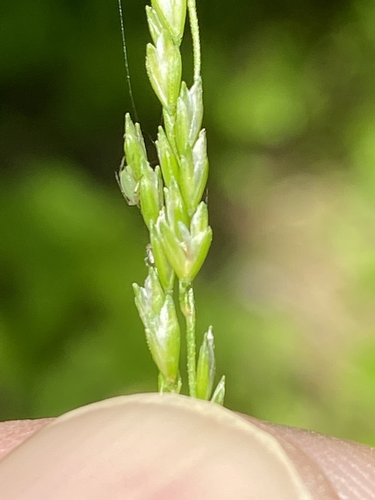
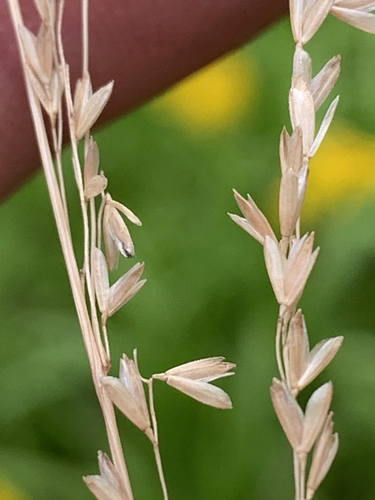
Sphenopholis nitida Shining wedge grass
Key Characteristics
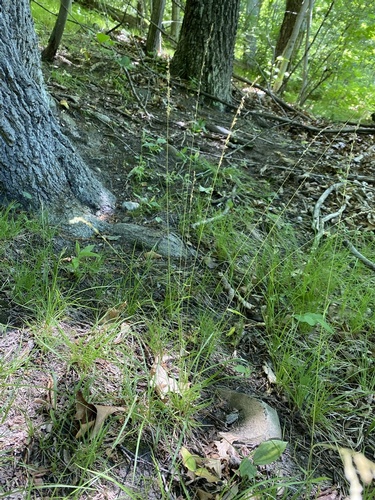
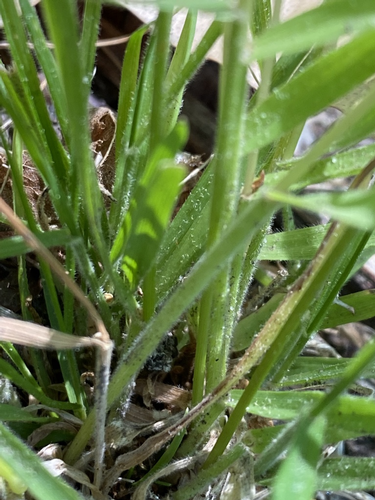
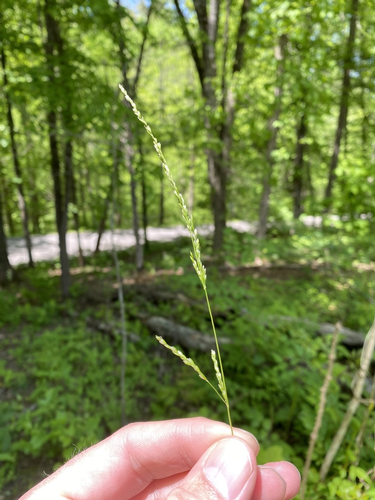
Slender, tufted grass, 30–70 cm tall with softly pubescent leaves. The panicle is few-flowered, diffuse, narrow, lax, and loosely spreading until maturity, and then it becomes erect. It is distinguished from similar species by its sparce panicle, the shape of the second glume (i.e., broadly rounded), the width of the folded first glume (i.e., greater than 0.3 mm), the relative difference in width between the first and second glume (i.e., significantly wider than first), larger anthers (0.7–1.5 mm), and usually awnless lemmas.
Status and Rank
US Status: No Status/Not Listed
State Status: SC - Special Concern (rare or uncertain; not legally protected)
Global Rank: G4 - Apparently secure
State Rank: SNR - Not ranked
Occurrences
| County | Number of Occurrences | Year Last Observed |
|---|---|---|
| Allegan | 1 | 2021 |
| Kalamazoo | 2 | 2022 |
Information is summarized from MNFI's database of rare species and community occurrences. Data may not reflect true distribution since much of the state has not been thoroughly surveyed.
Habitat
Southern Michigan appears to be the northern extent of shining wedgegrass. It’s usually found in dry, rich, or moist woodlands in association with oak trees (Quercus sp.) and on rocky slopes and bluffs above streams and rivers.
Natural Community Types
For each species, lists of natural communities were derived from review of the nearly 6,500 element occurrences in the MNFI database, in addition to herbarium label data for some taxa. In most cases, at least one specimen record exists for each listed natural community. For certain taxa, especially poorly collected or extirpated species of prairie and savanna habitats, natural community lists were derived from inferences from collection sites and habitat preferences in immediately adjacent states (particularly Indiana and Illinois). Natural communities are not listed for those species documented only from altered or ruderal habitats in Michigan, especially for taxa that occur in a variety of habitats outside of the state.
Natural communities are not listed in order of frequency of occurrence, but are rather derived from the full set of natural communities, organized by Ecological Group. In many cases, the general habitat descriptions should provide greater clarity and direction to the surveyor. In future versions of the Rare Species Explorer, we hope to incorporate natural community fidelity ranks for each taxon.
Associated Plants
White oak (Quercus alba), chinquapin oak (Q. muhlenbergii), black oak (Q. velutina), red oak (Q. rubra), ironwood (Ostrya virginiana), basswood (Tilia americana), smooth pussytoes (Antennaria parlinii), Pennsylvania sedge (Carex pensylvanica), panic grass (Dichanthelium commutatum), witch-hazel (Hamamelis virginiana), round-lobed hepatica (Hepatica americana), cluster-leaved tick-trefoil (Hylodesmum glutinosum), cliffbreak (Pellaea spp.), downy Solomon seal (Polygonatum pubescens), fragrant sumac (Rhus aromatica), sassafras (Sassafras albidum), bluestem goldenrod (Solidago caesia), and heart-leaved aster (Symphyotrichum cordifolium) (MNFI 2026).
Management Recommendations
Status and targeted surveys for this species in dry-mesic southern forest of southern Michigan is warranted. Maintain healthy, intact forest and minimize fragmentation. Manage with regiment of prescribed burns where reasonable.
Survey Methods
Random meander search covers areas that appear likely to have rare taxa, based on habitat and the judgment of the investigator.
-
Meander Search
-
Survey Period: From first week of May to second week of July
-
References
Survey References
- Elzinga, C.L., D.W. Salzer, and J.W. Willoughby. 1998. Measuring and Monitoring Plant Populations. The Nature Conservancy and Bureau of Land Management, Denver. BLM Technical Reference 1730-1. 477pp.
- Goff, G.F., G.A. Dawson, and J.J. Rochow. 1982. Site examination for Threatened and Endangered plant species. Environmental Management 6(4): 307-316
- Nelson, J.R. 1984. Rare Plant Field Survey Guidelines. In: J.P. Smith and R. York. Inventory of rare and endangered vascular plants of California. 3rd Ed. California Native Plant Society, Berkeley. 174pp.
- Nelson, J.R. 1986. Rare Plant Surveys: Techniques For Impact Assessment. Natural Areas Journal 5(3):18-30.
- Nelson, J.R. 1987. Rare Plant Surveys: Techniques for Impact Assessment. In: Conservation and management of rare and endangered plants. Ed. T.S. Elias. California Native Plant Society, Sacramento. 8pp.
Technical References
- Britton, N.L. 1907. Manual of the Flora of the Northern States and Canada. 3rd ed. Henry Holt and Company, New York, New York, USA. Available at: http://hdl.handle.net/2027/nyp.33433010726937.
- Lamson-Scribner, F. 1906. The Genus Sphenopholis. Rhodora 8(92): 137-146.
- Reznicek, A.A., E.G. Voss, and B.S. Walters. 2011. Michigan Flora Online. University of Michigan. Web. Available at: https://michiganflora.net/. Accessed 28 April 2026.
- Voss, E. G., and A. A. Reznicek. 2012. Field Manual of Michigan Flora. University of Michigan Press, Ann Arbor, Michigan, USA. 990 pp.