

Plants and Animals
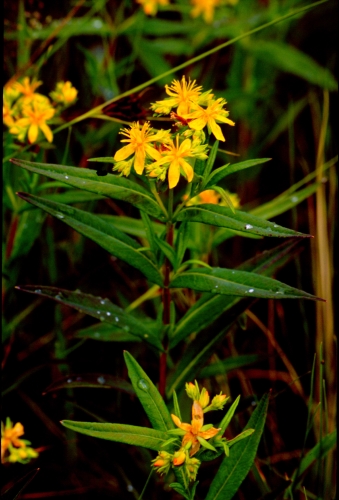
Hypericum adpressum Creeping St. John's-wort
Key Characteristics
Medium-sized rhizomatous forb (40-80 cm) of coastal plain marshes; leaves in whorls, narrowly elliptic to lanceolate and revolute, pinnately veined, 3.5-7 cm long; flowers 1-2 cm wide, yellow, in terminal clusters, sepals revolute.
Status and Rank
US Status: No Status/Not Listed
State Status: E - Endangered (legally protected)
Global Rank: G3 - Vulnerable
State Rank: S1 - Critically imperiled
Occurrences
| County | Number of Occurrences | Year Last Observed |
|---|---|---|
| Newaygo | 2 | 2024 |
Information is summarized from MNFI's database of rare species and community occurrences. Data may not reflect true distribution since much of the state has not been thoroughly surveyed.
Habitat
First collected in Michigan in 2005, this species is known only from the margins of coastal plain marshes.
Natural Community Types
For each species, lists of natural communities were derived from review of the nearly 6,500 element occurrences in the MNFI database, in addition to herbarium label data for some taxa. In most cases, at least one specimen record exists for each listed natural community. For certain taxa, especially poorly collected or extirpated species of prairie and savanna habitats, natural community lists were derived from inferences from collection sites and habitat preferences in immediately adjacent states (particularly Indiana and Illinois). Natural communities are not listed for those species documented only from altered or ruderal habitats in Michigan, especially for taxa that occur in a variety of habitats outside of the state.
Natural communities are not listed in order of frequency of occurrence, but are rather derived from the full set of natural communities, organized by Ecological Group. In many cases, the general habitat descriptions should provide greater clarity and direction to the surveyor. In future versions of the Rare Species Explorer, we hope to incorporate natural community fidelity ranks for each taxon.
Associated Plants
Bluejoint grass, prairie cordgrass, panic grass, wool-grass, three-way sedge, wire sedge, black-fruited spikerush, tall beak-rush, Canadian rush, hyssop hedge-nettle, lance-leaved violet, meadow-beauty, grass-leaved arrowhead, northern bugleweed, fireweed, Canadian St. John's-wort, larger Canadian St. John's-wort, lakes flat-topped goldenrod, southern blue flag, swamp dewberry, meadowsweet, and steeplebush.
Management Recommendations
This species requires conservation of habitat and protection of the hydrology, including maintenance of cyclical drawdown regime and water table. Maintain moist, open habitat. It is also vulnerable to ORV impacts and dredging and filling activities.
Survey Methods
Random meander search covers areas that appear likely to have rare taxa, based on habitat and the judgement of the investigator.
-
Meander search
-
Survey Period: From fourth week of June to first week of October
-
References
Survey References
- Elzinga, C.L., D.W. Salzer, and J.W. Willoughby. 1998. Measuring and Monitoring Plant Populations. The Nature Conservancy and Bureau of Land Management, Denver. BLM Technical Reference 1730-1. 477pp.
- Goff, G.F., G.A. Dawson, and J.J. Rochow. 1982. Site examination for Threatened and Endangered plant species. Environmental Management 6(4): 307-316
- Nelson, J.R. 1984. Rare Plant Field Survey Guidelines. In: J.P. Smith and R. York. Inventory of rare and endangered vascular plants of California. 3rd Ed. California Native Plant Society, Berkeley. 174pp.
- Nelson, J.R. 1986. Rare Plant Surveys: Techniques For Impact Assessment. Natural Areas Journal 5(3):18-30.
- Nelson, J.R. 1987. Rare Plant Surveys: Techniques for Impact Assessment. In: Conservation and management of rare and endangered plants. Ed. T.S. Elias. California Native Plant Society, Sacramento. 8pp.
Technical References
- Gleason, H. A., and A. Cronquist. 1991. Manual of Vascular Plants of Northeastern United States and Adjacent Canada. 2nd Ed. The New York Botanical Garden, New York, New York.
- Gray, A. 1950. Gray's Manual of Botany; eighth ed. Van Nostrand Reinghold, New York. 1632pp.
- Holmgren, N.H. 1998. Illustrated Companion to Gleason and Cronquist's Manual. Illustrations of the vascular plants of Northeastern United States and adjacent Canada. New York Botanical Garden, Bronx. 937pp.
- Mohlenbrock, R.H. 1986. Guide to the Vascular Flora of Illinois. Southern Illinois University Press, Carbondale. 507pp.