

Plants and Animals
Pellaea atropurpurea Purple cliff brake
Key Characteristics
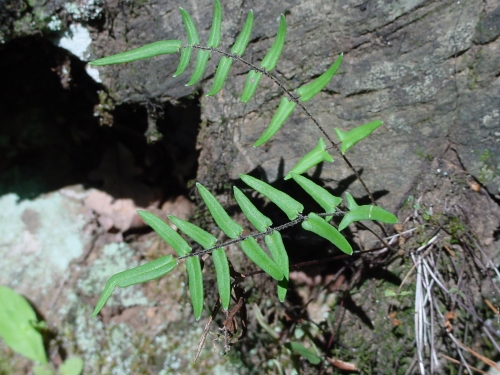
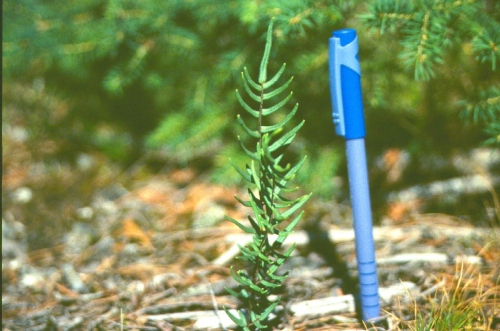
Small fern (50 cm) of sunny calcareous rocks in the Upper Peninsula; leaves triangular and 2-3 times divided, arising from dark purple hairy stalks; sporangia borne on inrolled margins of pinnules.
Status and Rank
US Status: No Status/Not Listed
State Status: T - Threatened (legally protected)
Global Rank: G5 - Secure
State Rank: S2 - Imperiled
Occurrences
| County | Number of Occurrences | Year Last Observed |
|---|---|---|
| Chippewa | 2 | 2016 |
| Dickinson | 2 | 2001 |
| Keweenaw | 4 | 1987 |
Information is summarized from MNFI's database of rare species and community occurrences. Data may not reflect true distribution since much of the state has not been thoroughly surveyed.
Habitat
The purple cliff-brake is found on alkaline bedrock outcrops, cliff faces, ledges, and pavement areas in the Upper Peninsula.
Natural Community Types
- Alvar
- Limestone bedrock glade
- Limestone bedrock lakeshore
- Limestone cliff
- Limestone lakeshore cliff
- Volcanic cliff
For each species, lists of natural communities were derived from review of the nearly 6,500 element occurrences in the MNFI database, in addition to herbarium label data for some taxa. In most cases, at least one specimen record exists for each listed natural community. For certain taxa, especially poorly collected or extirpated species of prairie and savanna habitats, natural community lists were derived from inferences from collection sites and habitat preferences in immediately adjacent states (particularly Indiana and Illinois). Natural communities are not listed for those species documented only from altered or ruderal habitats in Michigan, especially for taxa that occur in a variety of habitats outside of the state.
Natural communities are not listed in order of frequency of occurrence, but are rather derived from the full set of natural communities, organized by Ecological Group. In many cases, the general habitat descriptions should provide greater clarity and direction to the surveyor. In future versions of the Rare Species Explorer, we hope to incorporate natural community fidelity ranks for each taxon.
Associated Plants
Creeping juniper, bearberry, poison ivy, fragile fern, wild columbine, common juniper, creeping juniper, Gillman's goldenrod, sand violet, chokecherry, and fly honeysuckle.
Management Recommendations
The species requires protection of the dry, rocky habitat from human foot traffic or clifftop development.
Survey Methods
Random meander search covers areas that appear likely to have rare taxa, based on habitat and the judgement of the investigator.
-
Meander search
-
Survey Period: From first week of June to fourth week of August
-
References
Survey References
- Elzinga, C.L., D.W. Salzer, and J.W. Willoughby. 1998. Measuring and Monitoring Plant Populations. The Nature Conservancy and Bureau of Land Management, Denver. BLM Technical Reference 1730-1. 477pp.
- Goff, G.F., G.A. Dawson, and J.J. Rochow. 1982. Site examination for Threatened and Endangered plant species. Environmental Management 6(4): 307-316
- Nelson, J.R. 1984. Rare Plant Field Survey Guidelines. In: J.P. Smith and R. York. Inventory of rare and endangered vascular plants of California. 3rd Ed. California Native Plant Society, Berkeley. 174pp.
- Nelson, J.R. 1986. Rare Plant Surveys: Techniques For Impact Assessment. Natural Areas Journal 5(3):18-30.
- Nelson, J.R. 1987. Rare Plant Surveys: Techniques for Impact Assessment. In: Conservation and management of rare and endangered plants. Ed. T.S. Elias. California Native Plant Society, Sacramento. 8pp.
Technical References
- Billington, C. 1952. Ferns of Michigan. Cranbrook Institute of Science Bulliten 32. 240pp.
- Cody, W.J. and D.M. Britton. 1989. Ferns and fern allies of Canada. Research Branch, Agriculture Canada. Publication 1829/E. 430pp.
- Coffin, B. and L. Pfannmuller, eds. 1988. Minnesota's Endangered Flora and Fauna. University of Minnesota Press, Minneapolis. 473pp.
- Flora of North America Editorial Committee. 1993. Flora of North America, North of Mexico. Volume 2: Pteridophytes and Gymnosperms. Oxford University Press, New York. 475pp.
- Gleason, H. A., and A. Cronquist. 1991. Manual of Vascular Plants of Northeastern United States and Adjacent Canada. 2nd Ed. The New York Botanical Garden, New York, New York.
- Gray, A. 1950. Gray's Manual of Botany; eighth ed. Van Nostrand Reinghold, New York. 1632pp.
- Holmgren, N.H. 1998. Illustrated Companion to Gleason and Cronquist's Manual. Illustrations of the vascular plants of Northeastern United States and adjacent Canada. New York Botanical Garden, Bronx. 937pp.
- Lellinger, D.B. 1985. A field manual of ferns and fern allies of the United States and Canada. Smithsonian Institute Press, Washington D.C. 389pp.
- Mickel, J.T. 1979. How to know the ferns and fern allies. The Pictured Key Nature Series. William C. Brown Company, Dubuque. 229pp.