

Plants and Animals
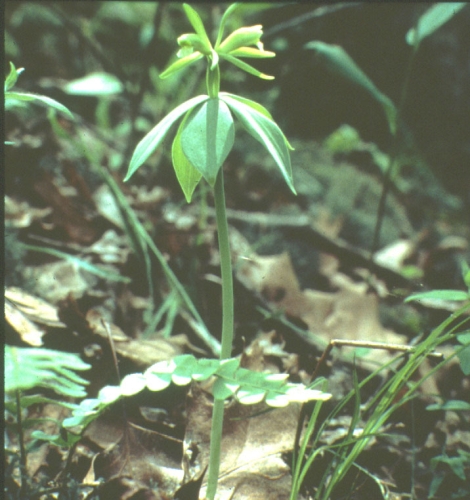
Isotria medeoloides Smaller whorled pogonia
Key Characteristics
Small orchid (5-20 cm) of swampy woods; superficially similar to cucumber root (Medeola virginiana) with 5-6 whorled leaves, but stem glabrous, glaucous and hollow; flower sessile with 3 short green sepals and a white lip.
Status and Rank
US Status: LT - Listed Threatened
State Status: X - Presumed extirpated (legally 'threatened' if rediscovered)
Global Rank: G2G3 - Rank is uncertain, ranging from imperiled to vulnerable
State Rank: SX - Presumed extirpated
Occurrences
| County | Number of Occurrences | Year Last Observed |
|---|---|---|
| Berrien | 1 | 1981 |
Information is summarized from MNFI's database of rare species and community occurrences. Data may not reflect true distribution since much of the state has not been thoroughly surveyed.
Habitat
The smaller whorled pogonia is known from a single locality in southwest Lower Michigan in low flat woods. It has not been seen in many years despite thorough surveys by expert botanists, though it may persist in other unsurveyed localities.
Natural Community Types
For each species, lists of natural communities were derived from review of the nearly 6,500 element occurrences in the MNFI database, in addition to herbarium label data for some taxa. In most cases, at least one specimen record exists for each listed natural community. For certain taxa, especially poorly collected or extirpated species of prairie and savanna habitats, natural community lists were derived from inferences from collection sites and habitat preferences in immediately adjacent states (particularly Indiana and Illinois). Natural communities are not listed for those species documented only from altered or ruderal habitats in Michigan, especially for taxa that occur in a variety of habitats outside of the state.
Natural communities are not listed in order of frequency of occurrence, but are rather derived from the full set of natural communities, organized by Ecological Group. In many cases, the general habitat descriptions should provide greater clarity and direction to the surveyor. In future versions of the Rare Species Explorer, we hope to incorporate natural community fidelity ranks for each taxon.
Associated Plants
Silver maple, red maple, swamp white oak, cinnamon fern, royal fern, skunk cabbage, marsh-marigold, mosses, sensitive fern, black ash, American elm, white ash, red ash, tamarack, red maple, yellow birch, spicebush, and prickly ash.
Management Recommendations
Prevent excessive logging and minimize human impact. Additional surveys in suitable habitat in the vicinity of the original collection are recommended.
Survey Methods
Random meander search covers areas that appear likely to have rare taxa, based on habitat and the judgement of the investigator.
-
Meander search
-
Survey Period: From third week of June to third week of June
-
References
Survey References
- Elzinga, C.L., D.W. Salzer, and J.W. Willoughby. 1998. Measuring and Monitoring Plant Populations. The Nature Conservancy and Bureau of Land Management, Denver. BLM Technical Reference 1730-1. 477pp.
- Goff, G.F., G.A. Dawson, and J.J. Rochow. 1982. Site examination for Threatened and Endangered plant species. Environmental Management 6(4): 307-316
- Nelson, J.R. 1984. Rare Plant Field Survey Guidelines. In: J.P. Smith and R. York. Inventory of rare and endangered vascular plants of California. 3rd Ed. California Native Plant Society, Berkeley. 174pp.
- Nelson, J.R. 1986. Rare Plant Surveys: Techniques For Impact Assessment. Natural Areas Journal 5(3):18-30.
- Nelson, J.R. 1987. Rare Plant Surveys: Techniques for Impact Assessment. In: Conservation and management of rare and endangered plants. Ed. T.S. Elias. California Native Plant Society, Sacramento. 8pp.
Technical References
- Case, F.W., Jr. 1987. Orchids of the Western Great Lakes Region. Revised ed. Cranbrook Institute of Science, Bull. 48. 251pp.
- Flora of North America Editorial Committee. 2002. Flora of North America, North of Mexico. Volume 26: Magnoliaphyta: Liliidae: Liliales and Orchidales. Oxford University Press, New York. 723pp.
- Gleason, H. A., and A. Cronquist. 1991. Manual of Vascular Plants of Northeastern United States and Adjacent Canada. 2nd Ed. The New York Botanical Garden, New York, New York.
- Gray, A. 1950. Gray's Manual of Botany; eighth ed. Van Nostrand Reinghold, New York. 1632pp.
- Holmgren, N.H. 1998. Illustrated Companion to Gleason and Cronquist's Manual. Illustrations of the vascular plants of Northeastern United States and adjacent Canada. New York Botanical Garden, Bronx. 937pp.
- Homoya, M.A. 1993. Orchids of Indiana. Indiana University Press, Bloomington. 276pp.
- Luer, C.A. 1975. The Native Orchids of the United States and Canada, Excluding Florida. Native Orchids U.S. & Canada. Barrons Educational Series, Hauppauge.
- Mohlenbrock, R.H. 1986. Guide to the Vascular Flora of Illinois. Southern Illinois University Press, Carbondale. 507pp.
- Swink, F. and G. Wilhelm. 1994. Plants of the Chicago Region, 4th ed. Indiana Academy of Science, Indianapolis. 921pp.
- Voss, E. G. 1972. Michigan Flora. Part I. Gymnosperms and Monocots. Bulletin of the Cranbrook Institute of Science and University of Michigan Herbarium. 488pp.