

Plants and Animals
Gentianella quinquefolia Stiff gentian
Key Characteristics
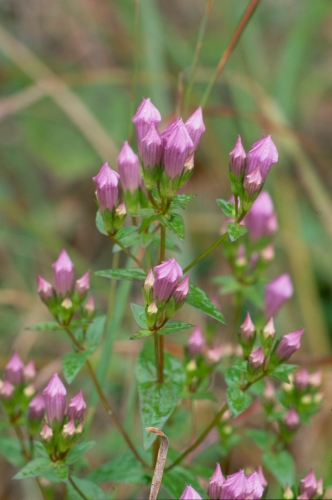
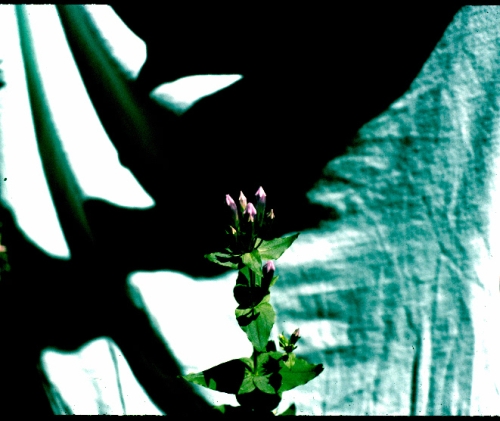
Small forb (40 cm) of calcareous soils; leaves opposite, lanceolate; tubular flowers pale blue, small (1-2 cm long) in dense terminal clusters.
Status and Rank
US Status: No Status/Not Listed
State Status: T - Threatened (legally protected)
Global Rank: G5 - Secure
State Rank: S2 - Imperiled

Occurrences
| County | Number of Occurrences | Year Last Observed |
|---|---|---|
| Berrien | 3 | 1998 |
| Cass | 1 | 1867 |
| Ionia | 1 | 1878 |
| Kalamazoo | 2 | 2020 |
| Kent | 1 | 1901 |
| Macomb | 1 | 1923 |
| Monroe | 1 | 2019 |
| Montcalm | 1 | 1900 |
| Oakland | 1 | 1923 |
| St. Clair | 1 | 1895 |
| Washtenaw | 4 | 2012 |
| Wayne | 2 | 1991 |
Information is summarized from MNFI's database of rare species and community occurrences. Data may not reflect true distribution since much of the state has not been thoroughly surveyed.
Habitat
Known from alkaline soils in marshy meadows, in mucky areas along river and stream banks, and wooded edges and hillsides.
Natural Community Types
- Floodplain forest
- Lakeplain oak openings
- Lakeplain wet prairie
- Lakeplain wet-mesic prairie
- Mesic northern forest
- Mesic southern forest
- Oak openings
- Southern hardwood swamp
- Southern shrub-carr
- Southern wet meadow
For each species, lists of natural communities were derived from review of the nearly 6,500 element occurrences in the MNFI database, in addition to herbarium label data for some taxa. In most cases, at least one specimen record exists for each listed natural community. For certain taxa, especially poorly collected or extirpated species of prairie and savanna habitats, natural community lists were derived from inferences from collection sites and habitat preferences in immediately adjacent states (particularly Indiana and Illinois). Natural communities are not listed for those species documented only from altered or ruderal habitats in Michigan, especially for taxa that occur in a variety of habitats outside of the state.
Natural communities are not listed in order of frequency of occurrence, but are rather derived from the full set of natural communities, organized by Ecological Group. In many cases, the general habitat descriptions should provide greater clarity and direction to the surveyor. In future versions of the Rare Species Explorer, we hope to incorporate natural community fidelity ranks for each taxon.
Associated Plants
Acer rubrum (red maple), Agalinis purpurea (purple false foxglove), Amphicarpaea bracteata (hog-peanut), Bromus kalmii (prairie brome), Carpinus caroliniana (blue-beech), Cirsium muticum (swamp thistle), Coreopsis tripteris (tall coreopsis), Cornus foemina (gray dogwood), Euthamia graminifolia (grass-leaved goldenrod), Eupatorium perfoliatum (boneset), Eutrochium maculatum (joe-pye-weed), Fraxinus nigra (black ash), Helenium autumnale (sneezeweed), Helianthus giganteus (tall sunflower), Liparis loeselii (Loesel's twayblade), Liriodendron tulipifera (tulip tree), Monarda fistulosa (wild-bergamot), Parnassia glauca (grass-of-Parnassus), Pedicularis lanceolata (swamp-betony), Physocarpus opulifolius (ninebark), Prunella vulgaris (self-heal), Prunus serotina (wild black cherry), Rubus flagellaris (northern dewberry), Rudbeckia fulgida (black-eyed-Susan), R. hirta (black-eyed-Susan), Scutellaria lateriflora (mad-dog skullcap), Solidago altissima (tall goldenrod), S. ohioensis (Ohio goldenrod), S. patula (swamp goldenrod), Sorghastrum nutans (Indian grass), Spartina pectinata (cordgrass), Symphyotrichum novae-angliae (New England aster), S. puniceum (swamp aster).
Management Recommendations
Status surveys are needed, as many records are quite old and there is little habitat data. Conservation of hydrology is likely necessary to maintain this species.
Survey Methods
Random meander search covers areas that appear likely to have rare taxa, based on habitat and the judgment of the investigator.
-
Meander search
-
Survey Period: From first week of September to fourth week of October
-
References
Survey References
- Elzinga, C.L., D.W. Salzer, and J.W. Willoughby. 1998. Measuring and Monitoring Plant Populations. The Nature Conservancy and Bureau of Land Management, Denver. BLM Technical Reference 1730-1. 477pp.
- Goff, G.F., G.A. Dawson, and J.J. Rochow. 1982. Site examination for Threatened and Endangered plant species. Environmental Management 6(4): 307-316
- Nelson, J.R. 1984. Rare Plant Field Survey Guidelines. In: J.P. Smith and R. York. Inventory of rare and endangered vascular plants of California. 3rd Ed. California Native Plant Society, Berkeley. 174pp.
- Nelson, J.R. 1986. Rare Plant Surveys: Techniques For Impact Assessment. Natural Areas Journal 5(3):18-30.
- Nelson, J.R. 1987. Rare Plant Surveys: Techniques for Impact Assessment. In: Conservation and management of rare and endangered plants. Ed. T.S. Elias. California Native Plant Society, Sacramento. 8pp.
Technical References
- Cooperrider, T.S. 1995. The Dicotyledonae of Ohio Part 2. Linaceae through Campanulaceae. Ohio State University Press, Columbus. 656pp.
- Gleason, H. A., and A. Cronquist. 1991. Manual of Vascular Plants of Northeastern United States and Adjacent Canada. 2nd Ed. The New York Botanical Garden, New York, New York.
- Gray, A. 1950. Gray's Manual of Botany; eighth ed. Van Nostrand Reinghold, New York. 1632pp.
- Holmgren, N.H. 1998. Illustrated Companion to Gleason and Cronquist's Manual. Illustrations of the vascular plants of Northeastern United States and adjacent Canada. New York Botanical Garden, Bronx. 937pp.
- Voss, E.G. 1996. Michigan Flora. Part III. Dicots (Pyrolaceae-Compositae). Bulletin of the Cranbrook Institute of Science and University of Michigan Herbarium. 622pp.