

Plants and Animals
Ipomoea pandurata Wild potato vine or man-of-the-earth
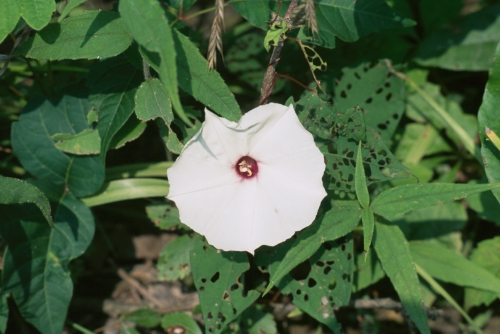
Key Characteristics
Perennial trailing or climbing vine of various habitats; stem glabrous; leaves heart-shaped with an acuminate tip; flowers funnel-shaped, white with a reddish-purple center, large (8 cm).
Status and Rank
US Status: No Status/Not Listed
State Status: T - Threatened (legally protected)
Global Rank: G5 - Secure
State Rank: S2 - Imperiled
Occurrences
| County | Number of Occurrences | Year Last Observed |
|---|---|---|
| Berrien | 3 | 2019 |
| Kalamazoo | 1 | 2007 |
| Monroe | 1 | 2018 |
Information is summarized from MNFI's database of rare species and community occurrences. Data may not reflect true distribution since much of the state has not been thoroughly surveyed.
Habitat
Known historically from a few collections in southern Lower Michigan where habitat was noted as woods and thickets, open fields, roadsides, and sandy ground. Recent collections are primarily from disturbed, weedy thickets in road and railroad rights-of-way, where the species may be adventive from populations in its more contiguous range south of Michigan.
Natural Community Types
For each species, lists of natural communities were derived from review of the nearly 6,500 element occurrences in the MNFI database, in addition to herbarium label data for some taxa. In most cases, at least one specimen record exists for each listed natural community. For certain taxa, especially poorly collected or extirpated species of prairie and savanna habitats, natural community lists were derived from inferences from collection sites and habitat preferences in immediately adjacent states (particularly Indiana and Illinois). Natural communities are not listed for those species documented only from altered or ruderal habitats in Michigan, especially for taxa that occur in a variety of habitats outside of the state.
Natural communities are not listed in order of frequency of occurrence, but are rather derived from the full set of natural communities, organized by Ecological Group. In many cases, the general habitat descriptions should provide greater clarity and direction to the surveyor. In future versions of the Rare Species Explorer, we hope to incorporate natural community fidelity ranks for each taxon.
Associated Plants
In its native barrens habitats, documented associates include Asclepias syriaca (common milkweed), A. tuberosa (butterfly weed), Euphorbia corollata (flowering spurge), E. cyparissias (cypress spurge), Quercus alba (white oak), Rhus copallina (shining sumac), and Schizachyrium scoparium (little bluestem). In disturbed areas, the species occurs with a variety of native and non-native species.
Management Recommendations
A status survey is recommended to compile more thorough habitat information. If found, it would likely benefit from activities that maintain a partially open canopy such as prescribed burning and control of excessive woody brush.
Survey Methods
Random meander search covers areas that appear likely to have rare taxa, based on habitat and the judgment of the investigator.
-
Meander search
-
Survey Period: From first week of July to fourth week of August
-
References
Survey References
- Elzinga, C.L., D.W. Salzer, and J.W. Willoughby. 1998. Measuring and Monitoring Plant Populations. The Nature Conservancy and Bureau of Land Management, Denver. BLM Technical Reference 1730-1. 477pp.
- Goff, G.F., G.A. Dawson, and J.J. Rochow. 1982. Site examination for Threatened and Endangered plant species. Environmental Management 6(4): 307-316
- Nelson, J.R. 1984. Rare Plant Field Survey Guidelines. In: J.P. Smith and R. York. Inventory of rare and endangered vascular plants of California. 3rd Ed. California Native Plant Society, Berkeley. 174pp.
- Nelson, J.R. 1986. Rare Plant Surveys: Techniques For Impact Assessment. Natural Areas Journal 5(3):18-30.
- Nelson, J.R. 1987. Rare Plant Surveys: Techniques for Impact Assessment. In: Conservation and management of rare and endangered plants. Ed. T.S. Elias. California Native Plant Society, Sacramento. 8pp.
Technical References
- Cooperrider, T.S. 1995. The Dicotyledonae of Ohio Part 2. Linaceae through Campanulaceae. Ohio State University Press, Columbus. 656pp.
- Gleason, H. A., and A. Cronquist. 1991. Manual of Vascular Plants of Northeastern United States and Adjacent Canada. Second edition. The New York Botanical Garden, Bronx. 910pp.
- Godfrey, R.K. and Wooten. 1981. Aquatic and Wetland Plants of Southeastern United States. Dicotyledons. University of Georgia Press, Athens. 712pp.
- Gray, A. 1950. Gray's Manual of Botany; eighth ed. Van Nostrand Reinghold, New York. 1632pp.
- Holmgren, N.H. 1998. Illustrated Companion to Gleason and Cronquist's Manual. Illustrations of the vascular plants of Northeastern United States and adjacent Canada. New York Botanical Garden, Bronx. 937pp.
- Mohlenbrock, R.H. 1986. Guide to the Vascular Flora of Illinois. Southern Illinois University Press, Carbondale. 507pp.
- Swink, F. and G. Wilhelm. 1994. Plants of the Chicago Region, 4th ed. Indiana Academy of Science, Indianapolis. 921pp.
- Voss, E.G. 1996. Michigan Flora. Part III. Dicots (Pyrolaceae-Compositae). Bulletin of the Cranbrook Institute of Science and University of Michigan Herbarium. 622pp.
- Voss, E.G., and A.A. Reznicek. 2012. Field Manual of Michigan Flora. University of Michigan Press, Ann Arbor, MI. 1008 pp.