

Plants and Animals
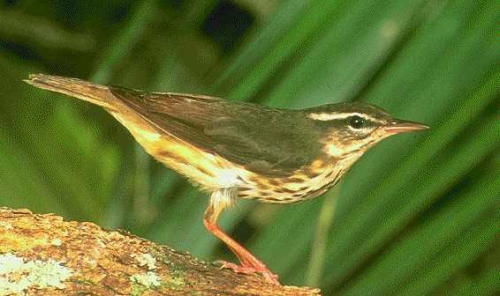
Parkesia motacilla Louisiana waterthrush
Key Characteristics
The Louisiana waterthrush is a large, brownish warbler, with average length and wingspan of 6 inches (15.5 cm) and 9.5 inches (24.5 cm), respectively. Its upper parts are brown, its breast is white with brown streaks and its flanks have a faint buffy (not yellow) tint. It has a bold white line extending over its eye to the back of its head, flaring somewhat farther back. Tail bobbing is common and is more exaggerated than the similar looking Northern Waterthrush. The two waterthrushes are easily separated by their song.
Status and Rank
US Status: No Status/Not Listed
State Status: T - Threatened (legally protected)
Global Rank: G5 - Secure
State Rank: S2 - Imperiled
Occurrences
| County | Number of Occurrences | Year Last Observed |
|---|---|---|
| Allegan | 2 | 2025 |
| Barry | 1 | 2008 |
| Berrien | 1 | 1989 |
| Calhoun | 1 | 2010 |
| Cass | 1 | 2009 |
| Hillsdale | 1 | 2014 |
| Ionia | 2 | 2021 |
| Kalamazoo | 1 | 1986 |
| Kent | 2 | 2023 |
| Manistee | 1 | 2021 |
| Mason | 3 | 2020 |
| Montcalm | 2 | 2024 |
| Muskegon | 2 | 2018 |
| Newaygo | 1 | 2013 |
| Oceana | 1 | 2003 |
| St. Clair | 1 | 2011 |
| Tuscola | 1 | 2016 |
| Van Buren | 1 | 2021 |
| Washtenaw | 1 | 2005 |
Information is summarized from MNFI's database of rare species and community occurrences. Data may not reflect true distribution since much of the state has not been thoroughly surveyed.
Habitat
Louisiana waterthrushes prefer broad forested areas along clear streams and may nest right on the stream bank in exposed roots.
Natural Community Types
For each species, lists of natural communities were derived from review of the nearly 6,500 element occurrences in the MNFI database, in addition to herbarium label data for some taxa. In most cases, at least one specimen record exists for each listed natural community. For certain taxa, especially poorly collected or extirpated species of prairie and savanna habitats, natural community lists were derived from inferences from collection sites and habitat preferences in immediately adjacent states (particularly Indiana and Illinois). Natural communities are not listed for those species documented only from altered or ruderal habitats in Michigan, especially for taxa that occur in a variety of habitats outside of the state.
Natural communities are not listed in order of frequency of occurrence, but are rather derived from the full set of natural communities, organized by Ecological Group. In many cases, the general habitat descriptions should provide greater clarity and direction to the surveyor. In future versions of the Rare Species Explorer, we hope to incorporate natural community fidelity ranks for each taxon.
Management Recommendations
Waterthrushes need natural substrates along forested streams and rivers. Logging, forest fragmentation and shoreline hardening all harm this species. Do not remove fallen trees along the shoreline whenever possible. Do not mow, remove brush, trees, use herbicides, or insecticides in areas known or likely to support nesting pairs of waterthrushes.
Active Period
Migration from fourth week of March to first week of May
Migration from fourth week of July to first week of September
Nesting from first week of May to fourth week of June
Survey Methods
Surveys for this species are typically point counts or transects through suitable habitat during the breeding season.
Point count, transect
Survey Period: From first week of May to fourth week of June
Time of Day: Morning (sunrise)
References
Survey References
- Bibby, C.J., N.D. Burgess, and D.A. Hill. 1992. Bird Census Techniques. Academic Press, New York.
Technical References
- Dunn, J. and K. Garrett. A Field Guide to Warblers of North America. Houghton Mifflin, Boston. 672pp.