

Plants and Animals
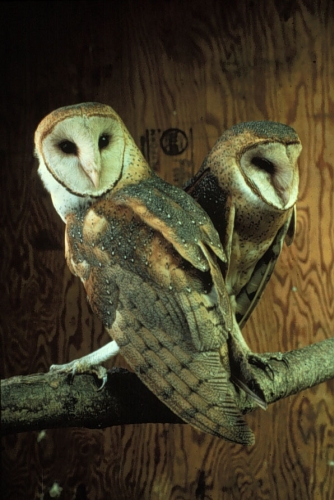
Tyto alba Barn owl
Key Characteristics
A medium-sized owl 16 inches (41 cm) in length. The Barn owl has pale tawny upperparts and white under parts. The heart-shaped white facial disk and dark eyes are distinctive.
Status and Rank
US Status: No Status/Not Listed
State Status: X - Presumed extirpated (legally 'threatened' if rediscovered)
Global Rank: G5 - Secure
State Rank: S1 - Critically imperiled
Occurrences
| County | Number of Occurrences | Year Last Observed |
|---|---|---|
| Lapeer | 1 | 1978 |
| Monroe | 4 | 1982 |
Information is summarized from MNFI's database of rare species and community occurrences. Data may not reflect true distribution since much of the state has not been thoroughly surveyed.
Habitat
Barn owls may utilize a wide array of natural community types and agricultural lands. They may utilize large hollow trees, buildings, or nest boxes for nesting or roosting. Barn owls are less common where intensive agriculture dominates the landscape.
Natural Community Types
- Bur oak plains
- Coastal plain marsh
- Dry sand prairie
- Emergent marsh
- Great lakes marsh
- Lakeplain oak openings
- Lakeplain wet prairie
- Lakeplain wet-mesic prairie
- Mesic prairie
- Oak barrens
- Oak openings
- Wet prairie
- Wet-mesic sand prairie
For each species, lists of natural communities were derived from review of the nearly 6,500 element occurrences in the MNFI database, in addition to herbarium label data for some taxa. In most cases, at least one specimen record exists for each listed natural community. For certain taxa, especially poorly collected or extirpated species of prairie and savanna habitats, natural community lists were derived from inferences from collection sites and habitat preferences in immediately adjacent states (particularly Indiana and Illinois). Natural communities are not listed for those species documented only from altered or ruderal habitats in Michigan, especially for taxa that occur in a variety of habitats outside of the state.
Natural communities are not listed in order of frequency of occurrence, but are rather derived from the full set of natural communities, organized by Ecological Group. In many cases, the general habitat descriptions should provide greater clarity and direction to the surveyor. In future versions of the Rare Species Explorer, we hope to incorporate natural community fidelity ranks for each taxon.
Management Recommendations
The conversion of most agricultural systems from pasture-based to intensive row crop along with rodenticides have played a significant role in the population decline. Barn owls should benefit from programs like the Conservation Reserve Program (CRP) that preserve open grassy areas and crop rotations that include a fallow period. A major goal of roadside management should be to neither significantly reduces prey availability nor attracts owls to the road where they may be struck by vehicles. Nest box programs have been successful in assisting the recovery of Barn owls in other parts of their range.
Active Period
Nesting from first week of April to fourth week of July
Survey Methods
Barn owls are resident and may be found throughout the year; however, they are best surveyed for during the early nesting period using call playback at night. The call should be played at or near suitable habitat and may be conducted from the road shoulder. Thirty seconds of calls should be alternated with 30 seconds of silence over a 2 to 5 minute period. Several surveys no less than 10 days apart are recommended at each site to verify presence/absence of the Barn owl.
Call playback during nesting
Survey Period: From first week of April to fourth week of June
Time of Day: Night
References
Survey References
- Bibby, C.J., N.D. Burgess, and D.A. Hill. 1992. Bird Census Techniques. Academic Press, New York.
Technical References
- Evers, D.C. 1994. Endangered and Threatened Wildlife of Michigan. The University of Michigan Press, Ann Arbor. 412pp.
- Johnsgard, P.A. 1988. North American Owls. Smithsonian Books, Washington D.C. 352pp.