

Plants and Animals
Schinia indiana Phlox moth
Key Characteristics
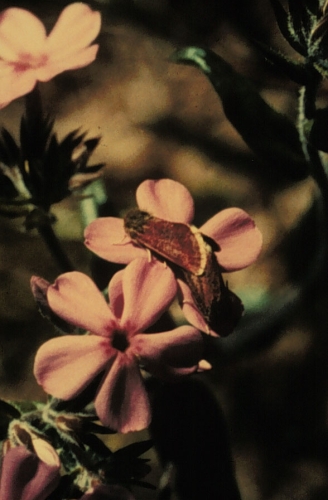
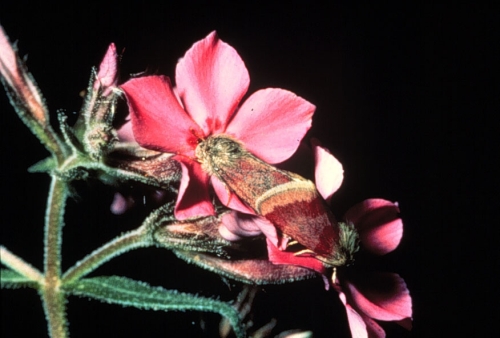
Small, 1.3 inch (3.3 cm) wingspan. The forewing is deep, purplish red above and predominantly chocolate-brown beneath with a wine-red spot at the apex. The hind wing is dark chocolate-brown above; beneath it is wine-red on the other and anterior half and chocolate-brown on the posterior and inner half. Caterpillars have a dark head capsule and cream to pale greenish yellow body. As the caterpillars age they have an orange-fawn head capsule and grayish-green to bright green body suffused with reddish brown and marked with whitish gray lateral strips and a reddish brown mid-dorsal band highlighted by a greenish gray median line.
Status and Rank
US Status: No Status/Not Listed
State Status: E - Endangered (legally protected)
Global Rank: G2G4
State Rank: S1 - Critically imperiled
Occurrences
| County | Number of Occurrences | Year Last Observed |
|---|---|---|
| Montcalm | 3 | 1990 |
| Newaygo | 1 | 1988 |
Information is summarized from MNFI's database of rare species and community occurrences. Data may not reflect true distribution since much of the state has not been thoroughly surveyed.
Habitat
Associated with the habitat for Karner blue butterflies. Michigan sites are in an area that formerly was pine-oak barrens with associated prairie openings, but now has succeeded to closed oak woods in which most of the prairie-like openings are caused by disturbances such as utility right-of-ways, roads, trails, off road vehicle activities, and home sites.
Specific Habitat Needs
Host plant needed in: Dry sand prairie; Dry-mesic prairie; Mesic prairie; Mesic sand prairie; Oak-pine barrens.
Natural Community Types
For each species, lists of natural communities were derived from review of the nearly 6,500 element occurrences in the MNFI database, in addition to herbarium label data for some taxa. In most cases, at least one specimen record exists for each listed natural community. For certain taxa, especially poorly collected or extirpated species of prairie and savanna habitats, natural community lists were derived from inferences from collection sites and habitat preferences in immediately adjacent states (particularly Indiana and Illinois). Natural communities are not listed for those species documented only from altered or ruderal habitats in Michigan, especially for taxa that occur in a variety of habitats outside of the state.
Natural communities are not listed in order of frequency of occurrence, but are rather derived from the full set of natural communities, organized by Ecological Group. In many cases, the general habitat descriptions should provide greater clarity and direction to the surveyor. In future versions of the Rare Species Explorer, we hope to incorporate natural community fidelity ranks for each taxon.
Management Recommendations
Management of the barrens and prairie landscape complex for high-quality prairie openings would benefit this species. Management units should be large enough to accommodate multiple patches of each habitat type and designed so that species can migrate from one patch to another as the habitat at a given site becomes unsuitable. Appropriately timed, prescribed burns could be an effective management tool for Phlox moth habitat. Protection of existing populations from collection and surveys to locate additional populations are necessary.
Active Period
Flight from fourth week of May to second week of June
Survey Methods
Adults are well camouflaged on the flowers of Phlox pilosa, where they spend much of their time. Their wings are slightly darker than fresh blossoms, more closely resembling a partially dried corolla. Visually inspecting phlox flowers is the best method of locating this moth.
Visual, aerial net
Survey Period: From fourth week of May to second week of June
Time of Day: Daytime
References
Survey References
- Martin, J.E.H. 1977. The Insects and Arachnids of Canada (Part 1): Collecting, preparing, and preserving insects, mites, and spiders. Publication 1643. Biosystematics Research Institute, Ottawa.
Technical References
- Evers, D.C. 1994. Endangered and Threatened Wildlife of Michigan. The University of Michigan Press, Ann Arbor. 412pp.
- Hardwick, D.F. 1970. The Genus Euxoa (Lepidoptera: Noctuidae) in North America. I. Subgenera Orosagrotis, Longivesica, Chorizagrotis, Pleonectopoda, and Crassivesica. Memoirs of the Entomological Society of Canada 67:177pp.
- Schweitzer, D. 1994b. Recovery goals and methods for Karner blue butterfly populations. Pages 185-193 in Andow, D.A., R. Baker and C.P. Lane, eds., Karner blue butterfly: a symbol of a vanishing landscape. Minnesota Agricultural Experiment Station, University of Minnesota, Miscellaneous Publication, Twin Cities 84-1994.